Luchazi people and their heritage.
Luchazi people
The Luchazi (or Lucazi) are a Bantu ethnic group indigenous to Angola. They also have significant historical and cultural presence in Zambia and Namibia. KaLuchazi (the plural being VaLuchazi) is a term used to indicate member of a Luchazi people. Luchazi is a name of a river, and it was used to refer to early communities that settled along the Luchazi River in eastern Angola. The Luchazi River is a tributary of Luena River. In eastern Angola, names of ethnic groups are based on the names of the rivers or some other characteristic feature of the ecology.
Sometimes the name
of an ethnic or sub-ethnic group is derived from the clan's name or personality
of a famous chief. In 1923, Emil Pearson (People of the Aurora and Tales of the Aurora’, 1977) collected an oral tradition among the
Lwimbi in the Kwanza valley that claimed that the Lwimbi are part of the
Luchazi people. It is reported that their chief called Lwimbi had a quarrel
with a Luchazi Chief called Muangana Mueni Ngongola. After that bitter quarrel, Chief Lwimbi with his followers left the Luchazi territory and settled in the Kwanza valley. The first known chief of the Lwimbi people was Muangana Mueni Chikungulu who was a cousin to Muangana Mueni Chivueka Mukuma. Muangana Mueni Chikungulu established his palace at Mbanjela. At that time, there was a Ovimbundu chief by the name of Ndumba ya Chilombo at Kuandulu who used to send his subjects into Muangana Mueni Chikungulu's area to capture slaves. Another Ovimbundu chief by the name of Ndunduma from Bailundu also used to carry out raids to capture slaves in Luchazi territories. When Muangana Mueni Chikungulu died, he was succeeded by Muangana Mueni Lwimbi. In the same year, Emil Pearson (author of the book: 'People of the Aurora and Tales of the Aurora’ (1977 also got an oral report that the Ngondzelo people
considered themselves to be a split-off from the Luchazi group.
Emil Pearson wrote that the Luchazi are further sub-divided according to their settlement areas in Angola. These are VaLuchazi lua ntunda (referring to the group settled up on high ground) and VaLuchazi lua ndonga (referring to the group settled in areas along the banks of the rivers).
Ngangela people
The Luchazi belong to a cluster of Bantu people called the Ngangela. Geographically, the Ngangela are found in the following provinces of Angola: Bie, Moxico, Cuando-Cubango and Cunene. Ngangela simply means the source of the sun or place of the rising sun; there is an old Luchazi saying, "Mu Ngangela mu na tili mu na ce" meaning when the place of the rising sun is red, it is dawn. The word Ngangela is also used to refer to a cluster of ethnic groups of the south-eastern and central Angola, and these are people who have common words such as 'Nga', 'Ange', 'Nguange' in their languages. Ngangela is a descriptor acceptable and often used interchangeably by some ethnic groups, however, many ethnic groups have individual preferences on how they would like to be described.
The word Ngangela was commonly used by the European merchants and the pombeiros (itinerant traders, typically of African or mixed descent, who operated in the interior of Angola on behalf of Portuguese traders during the Atlantic slave trade) in the 18th century to describe the ethnic groups of people occupying the areas of south-eastern and central territories of the Portuguese colony of Angola. After the enactment of Native Statue in 1926, the Portuguese military colonialists and the pombeiros massively used the word 'Ngangela' in a derogatory way to imply primitiveness or uncivilized people of the east.
According to Oxford Research Encyclopaedia (The History of Angola), "In 1926, the Native Statute (Estatuto Político, Social e Criminal dos Indígenas de Angola e Moçambique) created a special legal status for African “natives,” the Indigenato, and structured relations between indígenas (“natives”) and não-indígenas (“non-natives”). These legal categories codified existing categories and practices. In order to be deemed civilizado (“civilized,” the legal term to refer to black and mixed-raced people who were not under the Native Statue, and considered Portuguese citizens), black and mixed-raced people had to pass an examination administered by a colonial official. The process lacked centralized oversight; there was no standard exam, only a series of questions determined by the official involved. The indigenous people of central and south eastern Angola were legally considered not to citizens until 1962. In 1950, only 30,000 Africans-less than 1 percent of the 4.6 million Africans in Angola-were officially recognized as “civilized.” In effect, the Indigenato codified a caste system with a small, mostly white elite and a large African underclass denied the rights of citizenship. Achieving civilizado status exempted one from forced labour and allowed Portuguese authorities to hold up the tightly controlled access to citizenship as an example of what it deemed to be its civilizing mission in Angola".
The word Ngangela has been portrayed as derogatory by some people because it is associated with past racist attitude of Portuguese colonialists, while many other people have embraced it as a descriptor of their historic groups. During its five centuries of colonization, Portugal treated the indigenous people of the colony of Angola mostly with indifference or hostility especially those who occupied the southeastern and central regions of the colony who were denied the opportunity to write the examination as prescribed in the Native Statue.
In his book entitled ‘People of the Aurora and Tales of the Aurora’ (1977), Emil Pearson identified the following ethnic groups of people as the VaNgangela: Luchazi, Nyemba, Luimbi, Nkangala, Ngondzelo, Yauma, Chimbandi and Mbuela (Ambuela). Other tribes also identified as VaNgangela include the Ndundu, Mbalundu and Songo.
Please note that this blog has been written for public education, analysis and reflection. The focus is on the heritage and way of life of the Luchazi people. Readers are encouraged to look at multiple sources and stay engaged as new information emerge. The blog will always be updated according to the Cikota ca Luchazi historical discoveries through their Luchazi royal rulers.
Geographical location of Luchazi people
The Luchazi people use the names of rivers to refer to geographical locations. The original homeland of the Luchazi is the watershed land between the rivers and tributaries which pour their waters into the Zambezi River to the east (Zambezi River Basin) and Cuanza (Kwanza), Cunene (Kunene) and Kukema rivers which flow towards the Atlantic Ocean to the west. According to the missionary Emil Pearson in his book entitled People of the Aurora and Tales of the Aurora (1977), the Luchazi people expanded their settlements from Lwanjinga River to the west up to the Kwitu and beyond to the south and West.
The rivers are central markers in geographical space, and the rivers occupied by the Luchazi in Angola before the Portuguese are the main tributaries of the Zambezi River on its west bank namely, Luena, Lunguè-bungo (Lungwebungu), Lwanjinga, and Cuando (Kuando) including Cubango (Kuvangu) and Cuito which pour their waters into the Okavango River and swamps. Other rivers include Ndakavala, Musimoyi, Ntoyecha, Luantamba, Luchazi, Kanazi, Luyo, Lukuse, Chipandakano, Luzilakuti, Lukonya, Luvueyi Luondze, Lukula, Kueve and Cuanavale (Kuanavale).
In Northern Rhodesia (now Zambia), the Luchazi people settled in areas like Kanyange, Chivombo, Lunkuni, Lunyiwe, Lutali, Chozo, Kalombo, Makondo, Kambanda, Chiwezi, Musekelembwa, Lwampungu, Lwatembwe and other rivers in the Balovale district. Other Luchazi settlements include the Chikonkwelo, Kantsalya, Katuva, Mumbezi, Nyakuyuwa, Kalwilo, Mbulundu, and Maninga (now Manyinga). Today, the regions inhabited by Luchazi people are:
- Cuando-Cubango Province of Angola: Cuito Cuanavale to Mavinga.
- Southwest Moxico Province of Angola: Luchazi municipality and adjacent areas. Before the arrival of the Portuguese, the Luchazi people were centrally settled in what is now Moxico province by 14th century. In Moxico province, they occupied the territory from Kassai River in the north, Tembe, a commune of Luchazi municipality bordering Bie province in the west, up to Luanginga River in Bundas municipality in the south and in the Luzo, now Luena provincial capital east bordering with Leua municipality.
- North-western Province of Zambia: Kabompo district, Mufumbwe district and Zambezi district.
- Western Province of Zambia: Kaoma district, Lukulu district and Kalabo district.
- Namibia: They are great in number in Kavango province; Caprivi Strip region and the Okavangu region.
- A sizable population is also found in Democratic Republic of Congo (DRC).
The Luchazi
people in Namibia and Zambia consider Angola as their ancestral homeland.
Luchazi ethnic identity
Luchazi language
Luchazi (Lucazi, antonym: Chiluchazi) is an indigenous Bantu language of Angola. It is also spoken in Namibia and Zambia. The language belongs to Ciokwe-Luchazi (K.13) class of the Niger-Congo language family (Language code: ISO 639-3 lch and Glottocode: lch 1239). The Language can also be referred to as Lujash, Lujazi, Lutchaz, Lutshase, Luxage, Ponda, and Chiluchazi depending on area.
Luchazi alphabet and pronunciation
Luchazi is written using the Latin alphabet, with most characters representing the same sound as in English, with some exceptions. The letters Q, W, X and Y are not part of the proper alphabet and appear only in names or in a few native words and in borrowed words from Portuguese and other languages. From the viewpoint of pure phonetics, the ordinary alphabet is inadequate, but by observing the general rules that follow, a person should have no difficulty. The vowels have the so-called Continental or Italian values. Below is the Luchazi alphabet pronunciation ( by Wolfram Siegel. Corrections and additions by Michael Peter Fustumum):
 |
| Luchazi alphabet and pronunciation |
The Luchazi Language: Prestige, Persistence, and Evolution
According to the 17th edition of Ethnologue, Luchazi is a prestige variety within the Ngangela language cluster. Encyclopaedia Britannica notes that during the 1920s, Portuguese colonial authorities attempted to impose Portuguese as the sole language of the Portuguese colony of Angola. These efforts ultimately proved futile, as the Luchazi people continued to use their language in everyday life. However, Portuguese gradually became the language of political power and leadership. As a result, those who did not speak Portuguese were effectively excluded from the political process—a heavy price paid by the Luchazi and other Ngangela-speaking peoples, which pushed them to the margins of political participation.
Axel Fleisch, in his book Lucazi Grammar: A Morphosemantic Analysis, observes: “Although the number of Lucazi speakers is difficult to estimate, the language must be considered one of the major languages of southern central Africa. Several hundred thousand individuals use one of the mutually intelligible Ngangela varieties. How many of them consider themselves Lucazi speakers is unknown. So far little has been published on the languages of south-eastern Angola.”
The influence of the language even extends to other groups. The Bible Society of Angola notes that the Chiluchazi New Testament was first published in 1935. However, its release was met with local resistance; oral accounts describe an attack on a Christian mission where Bibles were burned by a tribe that accused missionaries of over-promoting the Luchazi language. This group rejected the translation entirely, opting instead for the Lunda-Ndembu version. It wasn't until 1963 that the full Holy Bible, titled Mbimbiliya ya ku Lela, was published. Since then, Luchazi media has expanded further, including a dubbed version of the 1979 Jesus film.
Additionally, according to the Bible Society of South Africa, the Luchazi language was used by the !Xuhn (San) people in church services prior to the publication of the !Xuhn Bible in 2018. The Society states: “About 4,000 San who live in Platfontein, near Kimberley in the Northern Cape, speak !Xuhn. The group is mainly from Angola and has been living in South Africa for more than 20 years. Almost 10,000 to 50,000 speakers of this language still live in Angola and Namibia.
The group in Platfontein has a school, a church and a radio station, but not a Bible. Scripture reading is done using Luchazi (an Angolan language) and Afrikaans Bibles.” (Source: Bible Society of South Africa website)
Dialects and regional variations
While Luchazi is a single language, it branches into regional dialects and varieties across Angola, much like Portuguese or English. These variations differ in vocabulary, spelling, pronunciation, and slang.
Emil Pearson in his book, Luchazi Grammar states, “Luchazi is the principal language of the Ngangela group. The language spoken by Ngangela group are remarkably similar to each other. Some eighteen different tribal names may be found among them, but the linguistic differences are not that great. Linguistic divergences must have been at work during the centuries of movement, and it is rather remarkable that the differences between the dialects are not greater. The intermarriage, colonialism and modern civilisation have had a leavening influence”.
Emil Pearson further states, “If you speak Luchazi you can travel from the Kunene River (the last big river before you reach the Atlantic Ocean) and go east for nearly a thousand miles before you exhaust the area where you will be understood”.
The Luchazi are further subdivided according to their settlement areas in Angola. These include VaLuchazi lua Ntunda, referring to those settled on higher ground, and VaLuchazi lua Ndonga, referring to those settled along riverbanks.
Vocabulary and pronunciation may vary between these groups. For example: cihuti and cifuti (country); cinavala, tinavala, and tenavala (aunt); mpanji and mpangi (cousin). Despite these variations, all such forms are accepted as Luchazi, depending on the region.
In some parts of Angola, particularly in Cuando Cubango Province, some Luchazi speakers use a hybrid form of the language incorporating vocabulary from Nyemba and Portuguese. In Bié and Moxico Provinces, other speakers use hybrid forms influenced by Ovimbundu, Chokwe, Luena (Luvale), Portuguese, and other neighboring languages. In Zambia, especially in the North-Western Province, Luchazi is often mixed with English and other Bantu languages, notably Luvale and Lunda. In Namibia, some Luchazi speakers incorporate vocabulary from Nyemba, Afrikaans, English, and Portuguese.
Chiyakayaka Chinganga, a Luchazi tribal elder speaking at a symposium on Luchazi history in 1971, remarked: “Some people criticize the Luchazi for marrying women from the tribes they found in Zambia, saying that if the Luchazi wanted to remain pure, they should have brought women from Angola for them to marry.”
Today, the Luchazi language is no longer exactly what it was in the past, nor will it remain unchanged in the decades to come. Nevertheless, the name Luchazi will continue to be retained as a powerful symbol of identity.
Traditions of the Luchazi people
Pattern of shared and non-shared behaviour
The Luchazi have the mukanda and the mungonge for the boy’s rites of passage while other tribes practice only the mukanda rites. The mukanda custom although shared with neighbouring tribes has some differences in the way it is conducted, and in the way the mukanda camp is constructed. For example, cizika mukanda is the term for the father of the head initiate, and the same term is used to refer to the head initiate during the circumcision, and because of intermarriage with other Ngangela ethnic groups, other Luchazi communities call the head initiate as Ntumba-kambongo. According to tribal elders, Ntumba-kambongo is a song which is sung during the mukanda. On the day of cessation of mukanda rites, the Luchazi initiates perform kutanga ritual and dance (kuhunga) during the day while other related tribes they do not dance or dance in the night; and the Luchazi mukanda camp is burned down during the day while other related tribes do it in the night. These seem to be small details, but they are extremely important as identity markers for a group and also their recognition as such by outsiders.
Population of the Luchazi people
The Luchazi population is estimated at between 900, 000 and 1 million individuals. According to the 2024 General Population and Housing Census, Angola’s population has grown significantly, reaching 36.6 million. Recent 2024 data from the Joshua Project and PeopleGroups.org place the Luchazi population in Angola between 759,000 and 791,000. This is a notable increase from the 400, 000 to 600,000 range previously cited by Ethnologue and Britannica. They are primarily concentrated in the Cuando Cubango and Moxico provinces in southeastern Angola.
The exact numbers for the Luchazi population across the DRC, Namibia, and Zambia remain uncertain. This statistical uncertainty is largely attributed to census reporting, where many individuals opt to register as Nyemba, Luvale (Luena), or other locally dominant related tribe.
Population losses were considerable due to slave trade, famine and the civil war that followed after independence in Angola. Jill R. Dias writes (Famine and Disease in the history of Angola 1830 to 1930 - The Journal of African History, Cambridge University press, 1981), "periods of exceptionally irregular rainfall, lasting several years, were preceded or accompanied by plagues of locusts which caused famines at least once every decade... A series of drought and smallpox can be discerned in Angola, at least since the 17th century." During the Angolan civil war (1975–2002), it is estimated that the warfare killed about a half million people; famine and disease are estimated to have killed an additional half million people as well.
Origins of Luchazi people
The origins of the Luchazi people remain largely elusive, though they are linked to the Congo Basin—a vast region spanning modern-day Cameroon, Gabon, and the Congos. Oral traditions name their ancestral home "Kalundi." By 500 BCE, likely as part of the broader Bantu expansion, the Luchazi settled in the Lualaba River region at a site known as Tusole.
However, the exact migratory paths into the Congo Basin remain a subject of scholarly debate. While linguistic evidence suggests a shared Proto-Bantu ancestry from West Africa, archaeologists disagree on the timing and nature of this dispersal. Some question whether it was a single mass migration or a gradual cultural diffusion. This leaves us with a choice of perspective: do we favour these linguistic and archaeological hypotheses, or do we consider broader evolutionary theories suggesting human origins in East Africa?
Advancements in DNA analysis now provide a biological framework to test long-standing claims of common ancestry among these ethnic groups. This genetic data is increasingly vital as the archaeological record remains fragmented. As Manfred K. H. Eggert (Genetizing Bantu: Historical insight or Historical Trilemma?-2016) argues, the current evidence from the Central African rainforest is too inconsistent to confirm a steady or large-scale Bantu expansion. This lack of physical evidence, combined with Dr. Chapirukha Kusimba’s (Field Museum, Chicago) observation regarding the lack of fieldwork in the DRC, Rwanda, and Uganda, suggests that the Bantu migration hypothesis remains an open scientific debate requiring further research.
For the purpose of this blog, we shall restrict ourselves to the accounts collected by early European missionaries and the oral accounts given by Luchazi tribal elders. According to an oral account obtained in 1920s by the missionary Emil Pearson, the Luchazi in Angola said that their forebears had originated from the east through the Congo, a long time before. When they had reached the sources of the Zambezi River, some of them turned south and settled in Northern Rhodesia (now Zambia). The Bulk of the people went southwest into what is now called Angola, while a small group stayed in the Congo. In Angola, they settled in what is now called Moxico province and expanded to areas of Bie province, and from Mavinga to Cuito Cuanavale establishing their communities around Cuando-Cubango area. Other groups in Angola settled closer to the Atlantic coast.
The reasons for Luchazi migration or movements
1. Traditional myths trace the migration from the Congo to a royal scandal: Queen Lueji (or Niakapamba Musompa) fell for a Luba hunter named Chibinda Ilunga. When she handed him her power, the chiefs were so outraged by this breach of protocol that they led their people away to form new kingdoms. This upheaval is often cited as the reason the Luchazi and other tribes left the DRC.
However, many scholars and Luchazi elders argue this narrative is more fiction than fact. They contend the story was popularized by Luba merchants and European settlers—such as Henrique Dias de Carvalho—to construct a unified "Pax Lunda" that served colonial and commercial interest, and is now incorrectly accepted by those seeking prestige through a Luba-Lunda connection. Critics point to two major flaws in the "Great Love Affair" theory:
- Cultural inconsistency: If the Luchazi left because they hated Chibinda’s takeover, it makes no sense that they still use the Vulye Kalombo (a ritual of subjugation) which actually praises that Luba from Kalombo (Chungu) lineage.
- Timeline mismatch: while Lueji ruled in the 1650s and Chibinda rose to power around 1664, the Luchazi were already established in Angola long before this, trading with the Portuguese and Dutch via the pombeiros.
Ultimately, the Luchazi likely never passed through the Luba-Lunda empire. The confusion often stems from failing to distinguish between the origins of the Luchazi people and the origins of their chieftaincy, which are two entirely different historical paths.
Daniel Musole (a Luchazi elder speaking at a symposium on Luchazi history convened by Muangana Mueni Kalunga II on August 28, 1971) said, "From time immemorial, the Luchazi people have never been ruled in their own land by any other chief of any other tribe. Never at any time in their history did the Luchazi people become subjects to any tribal chief other than their own". When the Portuguese were founding administrative posts and settlement towns such as Luanda (formerly São Paulo da Assunção de Loanda in 1576) the Luchazi were well established in Angola.
According to Britannica, the Lunda Empire was founded in 16th century as a merchant empire by Luba invaders, and the Lunda kingdom was founded in 16th century under Mwata Yamvo (or the so called Mwa Chiyavwa). The term 'Lunda Empire' was loosely used and is slowly being discredited. Many people are now asking, "What is an empire?" Moreover, many kingdoms
and chiefdoms in the Congo basin were autonomous and fairly independent of the
Lunda authority. The supporters of the Lunda empire are now using the term 'Lunda federation or states'. Most of these so-called empires were created by the early European merchants. It is also believed that to ensure effective control of this empire, Luba invaders and European merchants assigned a representative to each chiefdoms surrounding the empire to administer or carry out trade (just like the Barotse leadership sent representatives in its vast territory of the so called Barotse Protectorate), and some of these male representatives married the local women of that particular tribe and become rulers. This explains why some royal houses trace their chieftainship to Luba-Lunda states.
2. Luchazi people migrated to and settled in places where the climate was well-suited to Luchazi agricultural practices. The introduction and adoption of new crops such as maize (mundele), cassava (muandza) etc. influenced decisions to migrate. The crops grown by the Luchazi such as finger millet (valuku), bulrush millet (masangu), sorghum (masa), and African Multi-coloured corn (lipungu or pungu; this heirloom variety was common among the Nyemba people, and a song is usually sung, "Hali na tili yaye... ntsekentseke ku cipoke ndala... Hali na tili lipungu lia mu Nyemba", which shows its association with Nyemba people), grew best in the tropical savannah. Cassava and sweet potatoes (musambe) were a game changer because the tubers could be stored in the soil much longer than the grains and this enabled them achieve food security relatively easy. The cultivation of tuber plants required bigger plots of land.
3. Population growth influenced decisions to migrate to new settlements. Population growth occurred with the spread of agricultural activity due to iron-smelting activity which allowed them to create effective farming tools. Their devotion to agriculture, construction of good, thatched houses and maintenance of clean environment in village communities, lifted the living standards which led to population growth.
4. The adoption of livestock such as goats (vampembe), pigs (vangulu), cattle (vangombe) created the need for grazing land and conflicts over grazing land become frequent.
5. Trade: During the long period of commercial interaction with the Portuguese and Dutch traders at the Atlantic coast, the Luchazi trade caravan leaders noted such lands as might be suitable for Luchazi settlement if need arose. So as and when trade contact continued between the two groups, some Luchazi people came to settle near the trade caravan routes.
6. The outbreak of diseases such as smallpox in the Congo basin forced many Luchazi people to leave for the tropical savannah.
Prehistoric Angola and the Luchazi heritage
The Luchazi are one of the indigenous peoples of Angola. According to Encyclopædia Britannica, the foundations of modern Angolan society lie in agricultural cultures that emerged between roughly 1000 and 500 BCE. By the first millennium CE, these communities were already practicing ironworking and likely speaking ancestral forms of many of the languages heard across Angola today. By around 1500, complex societies and powerful kingdoms were firmly established, although tracing their precise origins remains a challenge.
Archaeological and historical research in the region has long been constrained by the legacy of colonial disruption, the protracted struggle for independence, and decades of civil war. In the present day, lingering social and political divisions often produce fragmented and contested historical narratives. Nearly every period of the region’s past—from deep prehistory to the modern era—is subject to debate. There is an evident struggle to "control" history in order to legitimize contemporary claims and identities. For this reason, we must always ask: Who is telling this story, and to what end? Many competing oral traditions, while valuable, lack the chronological markers or archaeological corroboration required for objective verification.
It is within this broader context that a common misconception must be addressed: the Luchazi people are not merely a “breakaway” group from the Lunda Empire or the wider Luba–Lunda states. Our existence as a distinct people did not suddenly emerge in the sixteenth or seventeenth century. The Luchazi (Lucazi) are a foundational and expansive population whose roots extend far deeper into the past. We must therefore be recognized as one of the major and ancient peoples of south-central Africa, rather than as a peripheral offshoot of later political formations.
Angola precolonial times
According to Area handbook series by the Federal Research Division - Library of Congress entitled "Angola: a country study" (third edition) states, "Although the precolonial history of many parts of Africa has been carefully researched and preserved, there is relatively little information on the region that forms contemporary Angola as it was before the arrival of the Europeans in the late 1400s. The colonizers of Angola, the Portuguese, did not study the area as thoroughly as British, French, and German scholars researched their colonial empires. The Portuguese, in fact, were more concerned with recording the past of their own people in Angola than with the history of the indigenous populations".
Despite this gap in the historical records, we can trace the Luchazi people back to the 14th century in what is now Moxico Province. They established a vast territory, spanning from the Cassai River down to the Luanginga, and stretching from the border of Bié in the west to the modern-day capital of Luena in the east.
Creation myth of the Luchazi people
The Luchazi people believe in a highly revered supreme deity known as Kalunga, the creator of all things and the source of all Luchazi clans. According to Luchazi cosmology, everything in existence is interconnected with the spiritual world and animated by a divine force that manifests itself throughout creation. This belief is reflected in the way certain natural and human phenomena are named: the sea is called mema a Kalunga, thunder ku-zima ca Kalunga, twins vana va Kalunga, tuhia va Kalunga, and many others. These names emphasize the sacred presence of Kalunga in both nature and human life.
Luchazi oral tradition traces the origins of the people to a mythical female figure named Nama, who is believed to have been created by Kalunga, the sky-being and supreme creator. Nama gave birth to Musompa Nama, from whom the Luchazi royal clan descends. Luchazi kings, queens, chiefs, and the wider community trace their ancestry back to Nama and to the founders of the various Luchazi clans.
Death and Afterlife
The Luchazi also believe in the continued existence of the spirit after death. According to tradition, the souls of the dead return to Kalunga, the supreme sky-being and creator of all nature. When a person dies, it is said that the soul goes back “ku cikuni ca Kalunga.” Death is therefore not seen as an end, but as the beginning of a longer existence. For this reason, death rituals—such as the erection of the cingina shrine—are performed to guide the spirit of the deceased to the next world. A traditional saying reflects this belief: "Kua zimina Kalunga ka ve ku tukako, vakuenu vantu ku va kala,” meaning, “You do not insult where the thunderbolt strikes, for your fellow human beings are there.” This sanctity of the afterlife is also expressed in traditional funeral songs such as this one:
Kukuenu nai muilu,
Nai muilu na kacata kasendo.
Group: "oh ye masiua-e."
Lead vocalist: "vana vange kati mu lila."
Lead vocalist: "Nguange vakuendze kati mu lila."
Lead vocalist: "vana vange kati mu lila."
All cultural rites of passage among the Luchazi are attributed to the grace and guidance of Kalunga and the ancestors. During important traditional ceremonies, the Luchazi invite the departed spirits, known as vakulu (ancestors), to return and watch over their descendants. In this way, spiritual knowledge and cultural values are preserved and passed down orally from one generation to the next.
The shift toward Christianity
Today, however, the Luchazi creation myth is less widely accepted. When European missionaries arrived in Luchazi communities in the nineteenth century, they classified indigenous beliefs as pagan and promoted the biblical creation narrative of Adam and Eve. As Christianity spread, many traditional practices and beliefs gradually declined. It is also important to note linguistic differences among the Ngangela-speaking peoples. While some Ngangela groups use the word Kalunga to refer to the Christian God, the Luchazi use the term Njambi for the Christian God. In the Luchazi language, Kalunga can also mean rain, further highlighting the richness and specificity of Luchazi spiritual concepts.
Ancestry of the Luchazi people
The Luchazi people traditionally trace their ancestry through the matrilineal line. This system is so deeply rooted that several clans are named after female ancestors, such as Kaposi ka Mununga or Cisehua ca Mununga. Traditionally, a person is identified by their mother’s name (for instance, Chipipa ca Vuime), though some communities have begun adopting the father’s name.
In this system, children belong to their mother’s lineage and are counted as members of her village. Consequently, the maternal uncle holds significant authority; his sister’s children are regarded as his closest blood relatives. Historically, in the event of divorce or the death of a spouse, custom dictated that children remain with the wife’s brother or uncle. This is captured in the proverb: “Ku sema ca ndemba, cali ua ya na vana vene”—the cockerel sires, but the hen leaves with her chicks. If children were not claimed by their maternal kin, paternal uncles even held the right to place them into indentured servitude.
This system also dictated inheritance. Upon a man's death, his estate and title were passed to his nephew (muihua) or grandnephew rather than his own biological children. In traditional Luchazi society, a man without nephews was considered deeply unfortunate, as he had no true heirs to carry on his legacy.
Life in ancient Luchazi society revolved around the woman, who was viewed as the origin of life and the guardian of tribal morals. Women were the primary food providers; while husbands cleared the farming land, the wives owned and managed the fields, growing the cassava and grain that sustained the family. Husbands maintained separate fields, known as mehia a ndemba, to provide for the extended family.
While the Luchazi remain matrilineal, they are "patrilocal," meaning families typically reside in the husband’s village. Today, these roles are shifting. As men have stepped into the role of primary food provider, many traditional female functions have been relegated to the domestic sphere. However, as the matrilineal system slowly evolves, modern Luchazi women are once again reclaiming their roles as key food providers for their families.
Luchazi traditional society
Prior to the advent of the white man, Luchazi society was a closely knit and well‑organized community, extending from the king through subordinate chiefs to ordinary citizens of the kingdom. Social bonds were strong, and within each cluster of villages, people were well acquainted with one another. The cohesion of Luchazi society rested on the general principle of good behaviour, guided by shared cultural values such as traditions, beliefs, and rituals, which shaped the conduct of the Luchazi people.
In the 1920s, a missionary named Emil Pearson observed that the Luchazi lived in groups of villages, usually surrounded by milemba trees planted by the inhabitants themselves. These villages were arranged in circular settlements centered on lineage-based village units known as limbo. Each lineage-based village was governed and administered by a noble tribal elder called ntunga limbo (village headman).
The ntunga limbo was responsible for the day-to-day affairs of the village and represented the community in all matters before the chief. In a typical Luchazi village, the ntunga limbo’s house was located on the western side, while the house of the designated successor, known as Suana, faced it from the east. At the center of the limbo stood a thatched structure called Ndzango, which served as a communal meeting place where men gathered to deliberate on village affairs. It was also the place where meals were served.
Villages were further divided into manageable homesteads governed by family elders known as vamiata. Each limbo possessed an ancestral shrine called Miyombo, where village elders conducted ritual prayers. In earlier times, elders also performed supernatural protective rites known as kukoteka limbo to safeguard their homesteads from witches, evil spirits, and wild animals.
Village elders established various taboos to maintain spiritual and social order. For example, a woman carrying a load on her head was required to lift the load and drop the twisted cloth cushion (nkata) on the ground before entering the village compound. Women were forbidden to draw water from streams or rivers after about 14:00 or 15:00 hours in the afternoon, and they were not allowed to pound meal flour after 15:00 hours. The pounding, cooking, or consumption of cassava leaves (ntsompo) within the village compound was prohibited. Additionally, fishing baskets (matambi) were not to be carried on the head within the village yard; instead, they had to be carried by hand or trailed along the ground with the hands held parallel to it.
Allocation of Duties and Tasks in Luchazi Society
Cultural values play a central role in shaping the Luchazi way of life. These values influence the allocation of duties, daily chores, life rituals, parenting practices, and disciplinary techniques for children. Traditionally, Luchazi society clearly distinguishes between men’s work and women’s work, with responsibilities assigned within the family and village setting.
Women’s Roles and Responsibilities
Cooking is exclusively the responsibility of women. Other duties include bearing and raising children, housekeeping, feeding and protecting the family, and ensuring food security. Women are responsible for ploughing and planting fields, as well as engaging in pottery, weaving, and other forms of traditional art.
The processing of agricultural products is carried out almost entirely by women. They sun-dry vegetables such as Roselle (mutete) and mushrooms, storing them in calabashes for later use. Luchazi women are also skilled brewers of both non-alcoholic beverages—such as visangua and milava—and alcoholic drinks, including vualua vua masangu, vimbuku, and kacipembe.
In traditional Luchazi society, there was no concept of a “housewife.” Farming was the primary occupation of women. From an early age, women were taught that their place was first in the field and then in the kitchen. Respect was accorded to women who were hardworking and self-sufficient in food production.
Women also participated actively in communal work. They worked together as a team in tasks such as pounding meal flour—often accompanied by joking and singing—caring collectively for village children, fetching water and firewood, collecting edible mushrooms and caterpillars, and fishing. Fishing methods included kusuinga, which uses fishing baskets called matambi, as well as malela mats for catching sardines.
Men’s Roles and Responsibilities
The traditional role of men in Luchazi society was closely linked to the protection of the family, clan, and tribe. A man was expected to carry a fighting axe (mutaka) and a dagger in a scabbard at all times. When necessary, he also carried a bow and arrows, including a muhotolo, stored in a mukopio (bag). This explains the warning: “KaLuchazi kati ua ku vundukila, a ku ku vulumuna,” meaning that care must be taken when grabbing a Luchazi person, as they may injure you.
Men formed the village’s working and fighting groups. Their main task was preparing virgin land for new fields by cutting down trees and shrubs. Other responsibilities included building and thatching huts, hunting, fishing (using miziva or makinda), beekeeping, participating in traditional ceremonies, forging farming implements and weapons, and defending the community.
Traditionally, a Luchazi man would refuse to perform household chores such as cooking, washing dishes, washing clothes, or sweeping, as these were considered women’s duties. A man who did such work would become a laughingstock. The kitchen was a restricted area for men, and a man was not expected to linger there. It was believed that if a woman struck a man with a cooking stick, he would become impotent. Likewise, when a woman was sweeping, a man was expected to keep his distance. If the broom accidentally touched him, he had to step on it immediately to avoid misfortune.
Men were expected to provide leadership at all times. If they failed to do so, women would take over. This belief is reflected in the saying: “Viali va ku tambeka, vandemba va ku keketa," literally meaning “the hens crow and the roosters cackle,” implying that women would take charge of village affairs if men lacked the strength or skill to lead.
The Role of the Extended Family
Extended family members—such as uncles, aunts, cousins, and grandparents—played important roles in transmitting traditional knowledge. They were responsible for teaching children cultural values and ensuring continuity of Luchazi customs, habits, and beliefs across generations.
Children’s Duties and Socialization
Boys and girls were raised differently in many respects, but the ultimate goal was the same: to prepare them to function effectively within Luchazi society. Children were expected to run errands, fetch firewood and water, help with weeding fields, and clean the village surroundings. They also assisted elderly members of the community by fetching water and firewood.
In every village, herding was assigned to boys. Their duties included running errands for elders and collecting firewood for the ndzango fires, as captured in the song: “Kanike ua tiavele vikuni ua lia ha ndzango.” (The child who gathered the firewood eats at the ndzango).
Boys who had undergone circumcision were further tasked with making traps to catch birds and rodents, which they gave to their mothers and other relatives.
Care for the Elderly
Very old people who had passed their productive years were treated with great respect and care by the entire village. This communal responsibility functioned as a form of traditional pension—a reward for their lifelong service to the family, clan, and community.
Luchazi customary code of conduct
Luchazi customary code of conduct is a set of social customs or norms which describes the Luchazi etiquette, emphasizing respect, compliance with conventional rules and consideration for other's feelings. It is a customary way in which a person behaves toward other people or the way a person behaves on a particular occasion. It involves a range of behaviours from social interaction to eating meals, associated with the Luchazi tradition of placing a high value on good behaviours. Here are the key aspects of the Luchazi customary code of conduct:
- Kasingimiko na kavumbi ku vakuluntu (Respect and honour to elders). Give respect and honour to those who are older than you, especially the elderly members of the village or community by greeting them first. Luchazi proverb says, "A li ha citsizi ke ku nona njamba." Meaning that when you are on the shoulders, the elephant you see is not yours. Give respect and honour to elders who have worked hard and set a strong foundation for you to see the world.
- Ku meneka na ku sambelela (greeting and reception). Use handclaps accompanied by verbal greeting when greeting nobles, elders, parents, father-in-law and mother-in-law. Avoid shaking hands and nodding. Use touch-and-clap greeting when greeting close friends or age mates or grandparents.
- Ku-konkoma (humility). In many social situations, avoid speaking to or addressing elders while standing. A young person should always kneel down or squat when speaking with an older person who is seated. If you are addressing a crowd, always ask for permission to stand and address the gathering from an older person present.
- ku handeka na ku langulula. Speak simply and plainly. Always explain where clarity is required. Do not dominate the conversation; allow others to speak. Avoid interrupting or finishing others' sentences.
- Vusilikinio na ku sunguluka (self control and sober minded). Keep your conversations at a respectful volume. Luchazi proverb says, "Ve ku aluluka ku muhela; mu kanua iya ua alulukilemo?" Meaning that people are able to turn around in bed, but who can turn around in the mouth?" The question is, who can turn around what the mouth has said?
- Ku handeka via ku santsuka (good speech). Avoid controversial topics or subjects unless you know the subject or the issue at hand. Luchazi proverb says, "Ua tsa mu ciliva ca mbala; ua samatela mutue." Meaning that he who is caught in another's trap has stuck his head into it.
- Ku halakana mua cili na ku yongola na mana. Listen attentively when an elder person is talking to you. Do not exchange words with an elderly person, and always keep quiet when he or she is rebuking or correcting you.
- Ku handeka via kavumbi (gracious talk). Using polite language when appropriate demonstrates courtesy. This includes using phrases like lisesa (excuse me), muane (please), eyo (yes), eua (affirm, confirm) and nja santsela (thank you) or nja sangala demonstrate courtesy and politeness.
- Ku-ononoka (obedience). Obey orders and instructions from parents, guardians and elders without question. Luchazi proverb says, "Via ku tuma, ku takinia, ni ku mina?" Meaning that which you are sent to do, is it to be chewed or swallowed. Just do what you have told to do; do not overthink.
- Menekela (morning visitation). In the morning, a person is expected to go and inquire about the health and well-being of his or her parents, grandparents, elders, the sick and other family members before embarking on his or her morning activities such as going to the farming fields, fishing, etc. This morning visitation is known as ku menekela. Hence the saying, Kamenemene ka ntumba, menekela a li na mana; kesi na mana ngueni, "tuhia nezila" (the first-born girl arises early in the morning for she knows it is wise to see how the others are doing; a foolish person, on seeing her, will say, "she has come for charcoal to start her fire").
- Vuhilanio (age mate). Maintaining personal space and avoid standing too close unless the person is a close friend or age mate. Avoid pointing with the index finger when speaking to a person older than you. It is considered impolite. Use the appropriate language when talking to a person older than you. Be careful in using the words such as "ove", "yove" when addressing a person older than you. Avoiding excessive closeness or touching with the opposite gender in social interactions is the characteristic of Luchazi culture.
- Singimika vaze va li na vana (respect those with children). Avoid calling a person with a child or children by his or her first name. Use the prefix Sa- (father of) or Nia- (mother of), for example, SaMusole (father of Musole) or NiaMusole (mother of Musole). Always use the name of the firstborn child.
- Singimika nokomueno na somueno (respect your mother-in-law or daughter-in-law and your father-in-law or son-in-law). A Luchazi man avoids contact with his mother-in-law (wife's mother). He is even expected to be distant and careful in his speech with his father-in-law (her father). The avoidance between the mother-in-law and the son-in-law is still practiced even today. Strict customs usually forbid their speaking to each other or looking at each other or shaking hands. If a young man sees his mother-in-law coming along a footpath, he will give way to the mother-in-law or plunge into the bush.
- Cizila ku vumbatela ku meso a vantu. In Luchazi society, public hugging and kissing are forbidden. Hugging parents and the opposite gender is not allowed. Be mindful of personal space and avoid over familiarity. Only grandparents are allowed to kiss the palm of their grandchildren as a sign of blessings.
- Cizila ku tana hamo na vampuevo. Grown up sons are not allowed to swim together with their mother and sisters, and daughters are not allowed to swim together with their father and brothers.
- Cizila ku kovela mu hondo ya Visemi. Traditionally, grown-up sons and daughters are not allowed to enter their parent's bedroom. A father is not allowed to enter his grown-up daughters' bedrooms, and a mother is not allowed to enter her grown-up sons' bedrooms. Likewise, grown brothers are not allowed to enter their sisters' bedrooms, and grown-up sisters are not allowed to enter their brothers' bedrooms.
- Cizila mpuevo ku hita ha kati ka ndzango. It was a taboo in the old days for any wife or young females of the village to pass through the middle of the open space of the village or go near the ndzango, except on the occasion such as a ceremony or during a ritual or causal dance. It was only elderly women or women past mensuration (menopause) who were free by custom to go or pass near the ndzango.
- Ku lipokuesa (temperance). Avoid over indulgence in food and drinks. Only adult men and women are allowed to drink and smoke. Women past childbearing age have privileges never allowed to them in their youth. They can share alcoholic drinks with men around the Ndzango. They can dance close to the masked dancers (Makisi).
- Cizila mpuevo ku vumbatela cipue ku kuata likisi. It is strictly a taboo for women to have any physical contact with any type of masked dancer (likisi), let alone have a handshake or hug a likisi. Touching or hugging a likisi by a woman or uninitiated man is considered an insult. Uncircumcised youth or man (Cilima) is not allowed to insult a likisi.
- Ku suvuluka (to be well-behaved). Traditionally, it is an offence to mention private parts in public especially the female genitals or sexual organs. Refraining from asking overly personal questions about a woman's monthly period or other private matter is considered polite.
- Sondoloka ku vantu ka u izi. Luchazi culture is reserved with a preference for distance in social interaction with strangers or uncircumcised people. Avoid handshake with strangers as you greet them. It is strictly taboo for a Luchazi man to share in certain social activities with an uncircumcised male (cilima). By tradition, uncircumcised men (vilima) are not accepted as equals; Luchazi men do not accept an uncircumcised male on an equal social basis.
- Ku tambula viuma na mavoko avali. Use both hands when receiving items or gifts from elders and always give using the right hand.
Luchazi traditional greetings
The Luchazi people have elaborate traditional greeting and welcome rituals that show their cultural values and social structure. These rituals are highly treasured and valued as they show courtesy, goodwill, and respect to the person being greeted, and the elegant welcoming rituals gives the visitor good impressions of the people welcoming him or her. These traditional rituals are deep rooted in the cultural values and defines how each individual should treat another within the social structure when it comes to greetings and welcoming etiquettes.
Luchazi traditional greetings have aspects of physical contact and non-contact, verbal and nonverbal. Basically, a Luchazi traditional greeting is a touch-and-clap which involves touching someone’s open palm once or twice, accompanied by two rounds of handclaps. Traditionally, there is no clasping of hands and no handshake. In this physical contact greeting, the individual initiating a greeting extends his or her right hand first to the other individual who in response extends his or her right hand, touching the extended palm, and then they together do two rounds of handclaps simultaneously. This is followed by inquiries about the health and well-being of each other including their families. This traditional greeting is typically used between friends of the same age and grandparents.
In non-contact, the traditional greeting is done by two or three rounds of handclaps. This type of greeting maybe verbal or nonverbal. Handclapping is considered to be a sign of respect and humility. It is done out of respect for the personal boundaries and cultural values of the individual that is being greeted and is the best way to maintain appropriate boundaries. Traditionally, greeting an older person differs from greeting friends or peers. Non-contact traditional greetings are confined to nobles such as chiefs, and when greeting parents, elders, fathers/mothers-in-law and strangers.
Traditionally, a young person is not supposed to extend his or her hand to greet his or her parents or an older person. When greeting a mother-in-law or father-in-law, the person maintains some distance and greets by three rounds of handclaps. The in-laws also respond with three rounds of handclaps and then followed by verbal greeting.
The Luchazi have cultural rules and norms on greetings. The traditional greeting norms state that a young person, especially those who have passed through the coming-of-age ceremonies, should always greet elders. When a young person meets an older person on the way, the young person is expected to greet the older person. If the young person bypasses without greeting, it will be considered a disrespectful act, and the behaviour will be attributed to bad tutoring at the mukanda or vuso. And this bad behaviour, in old days was curtailed or corrected at the coming-of-age ceremonies such as mungonge and ciuila rites. Traditions demand that a young person should always kneel down or squat when greeting a seated person who is older than him or her. Kneeling or squatting convey reverence to others.
Luchazi people have elegant traditional reception or welcoming (ku-sambelela) rituals. A visiting person is received with jubilant sayings of “hengo, hengo”, especially if the visitor is a relative from a distant place or village. When a visiting relative is seen entering the village compound, children or young person rush to meet him or her (known as kusesa) while saying “hengo nana or hengo tata or hengo yaya, etc.”, depending on the relationship with the visitor. After getting the luggage from the visitor, the welcoming party escorts the visitor (if male) to the ndzango and to the ntsenge (kitchen) if the visitor is female. The male visitor is usually offered a stool, and the female visitor is offered a reed mat. Then follows the traditional expressive greeting saying, “nana-mo or tata-mo or yaya-mo, etc.” Smiling and clasping the hand of the visitor if the visitor is a brother, sister or cousin, and in certain cases women shed tears of joy especially grandmothers or mothers. After completing these traditional greeting formalities, then follows the ritual of kuta muzimbu.
Kuta muzimbu is a traditional verbal narrative or chronicle or an account of events given eloquently by the visitor or by the head of the visiting party to the welcoming party and the village members. Often the muzimbu is spiced with Luchazi proverbial sayings. After the welcoming greeting, the head of the family or head of the welcoming party asks the visitor, “vati cihindu?” meaning “how are you?” The visitor or head of the visiting party acknowledges by giving a detailed account of their well-being including the family members of the village they are from, mentioning births, sicknesses and deaths. Secondly, the visitor or head of the visiting party gives an eloquent detailed account of the journey mentioning the rivers crossed, the villages they have passed through, and explaining the challenges encountered or experienced along the way. Thirdly, the visitor or head of the visiting party states the purpose or reasons for the visit. After finishing kuta muzimbu, the visitor or the head of the visiting party concludes the muzimbu by a round of handclaps. In response, the head of the family or welcoming party acknowledges the muzimbu and gives a traditional vote of thanks by reciting a summarized account of the narrative given by the visitor. Then the head of the family or welcoming party also gives an account of the state of situation in the village by articulating issues ranging from health, challenges experienced and deaths that occurred from the time the visitor or group last visited the village. The head of the welcoming party concludes by a round of handclaps. Then the visitor or head of the visiting party and the head of the family or welcoming party simultaneously kneel on one bended knee, touching the ground and then touching the chest, accompanied by a round of handclaps. Touching the ground symbolize the respect for the distance travelled by the visitors and acknowledging that the soil is the mother of nature that sustains humanity. The head of the family or welcoming party says, “tu suekenu muzimbu or tu mbilenu muzimbu.” Then the visitors, the head of the family or welcoming party and the village audience give a round of handclaps simultaneously.
Afterwards, the head of the welcoming party goes to inform the ntunga limbo and village elders about the visitors. If the visitor is a relative, the ntunga limbo or village elders promptly take the visitor to the village shrine, inviting the departed ancestors to watch over the visitor during the visit or stay. After performing the rituals at the miyombo, a chicken is slaughtered by cutting off the head and the visitor is made to jump over the spilled chicken blood, and this is called ku sindika. This is done so that the visitor can have a peaceful stay.
Travel and transport of Luchazi people
Historically, the Luchazi people traveled between villages primarily on foot. For long-distance expeditions that could last weeks or even months, they journeyed in organized groups to ensure collective security. The pace of these treks was dictated by the group’s size, composition, and the physical health of its members. Typically, young men—charged with carrying the bulk of the cargo—led the way, while village elders remained at the rear to supervise the group and assist those who became tired or fell ill. Oral traditions recount arduous journeys made by Luchazi men to the Atlantic coast for trade, or as far as South Africa and Rhodesia (modern-day Zimbabwe) to seek work in the mines.
In earlier times, social norms dictated that women and youths were not permitted to travel long distances without a male escort. Those who ventured out alone did so at great personal risk; if encountered by rival groups, they could be captured and declared "deserting slaves." Such captives were often traded for cattle or manufactured goods.
On the water, canoeing remains a vital mode of transport for communities settled along riverbanks. These vessels are essential for ferrying people and goods, as well as for daily fishing activities. Each canoe, known as a vuato, is expertly carved from a single large tree trunk and streamlined with pointed ends for better navigation. The vuato is propelled using a cilapo (paddle), operated by a navigator who may be either standing or seated.

Herbalism of the Luchazi people
Traditional herbal medicine remains a cornerstone of Luchazi society. When illness strikes, the Luchazi rely on remedies passed down through centuries of ancestral wisdom. These practices are deeply intertwined with spiritual beliefs; healing often involves a blend of botanical knowledge and sacred incantations.
For conditions like epilepsy, impotence, or infertility, the treatment includes purification rituals. These involve mixing specific herbs with the blood of a slaughtered animal, followed by the kuzima (sprinkling) and kukosa (smearing) of the mixture onto the patient. Following these cleansing rites, patients must adhere to strict taboos and dietary restrictions to ensure recovery.
Herbalism also addresses common ailments such as fevers, coughs, rashes, and STIs. While village elders hold a wealth of oral tradition regarding medicinal plants, complicated or prolonged illnesses require the expertise of a cimbanda. As a specialist in herbal preparations, the cimbanda utilizes various administration methods, including ku-niateka (warm compresses), ku-cata (incisions), steaming, and infusions.
Another specialized method is kuntsuka, used primarily for rectal issues. This involves administering a herbal mixture into the large intestine through the anus via a small, specially crafted gourd that acts as a pump. Through these diverse practices, the Luchazi continue to preserve a sophisticated system of holistic health.
Indentured servitude in Luchazi society
Historically, Luchazi kings, chiefs, and wealthy families held indentured workers as part of their estates. Unlike the harsh systems seen elsewhere, these individuals were often treated with care and integrated into the community. Owners acquired workers primarily to manage cassava fields, tend to livestock, and provide protection for the village.
Fair treatment was a strategic priority; by making workers feel like genuine members of the family or clan, masters ensured loyalty and discouraged desertion or internal conflict. Before the onset of the transatlantic slave trade, these workers were often entrusted with leading or participating in major trading expeditions.
Over time, diligent workers had the opportunity to build their own prosperity within the system. Once fully integrated, they became dedicated members of their adopted villages, even participating in armed conflicts to defend the community against external enemies.
Ideograms of the Luchazi people
The Luchazi people developed a sophisticated system of ideographic symbols known as tusona. Traditionally used as a script by kings, elders, and secret societies, this form of writing was esoteric, intended to be understood only by initiated members of the community. These ideograms were typically drawn in the sand or soil to represent complex ideas, proverbs, or historical events.
During his fifty-year tenure with the tribe, missionary Emil Pearson documented how the Luchazi exquisitely used these "sandgraphs" to preserve their history and oral traditions. He detailed his experiences with the Ngangela-speaking peoples of Angola in his book, People of the Aurora.
Beyond written symbols, the Luchazi utilized a specialized sign language to communicate privately in the presence of strangers. Additionally, they employed a "pathway telegraph" system—using specific arrangements of sticks or branches laid along a trail—to leave messages or warnings for those following behind them.

Luchazi lunar calendar
Traditionally, the Luchazi people followed a lunar calendar consisting of thirteen months, each with 28 days. Each month was given a name based on the appearance of the moon, a phenomenon known as kutentama ca ngonde, observed in the western sky after sunset. The Luchazi year began in April, marking the time when the harvest was ready.
Today, however, the Luchazi people have adopted the twelve-month system. The names of the months are now largely based on climatic conditions, vegetation patterns, and the annual temperature cycle. As a result, the names of the months may vary. (for example Angola has two climatic seasons and Zambia has three seasons). These months in Luchazi are:
- April = Ku-uana.
- May =Kuhu or kusamba.
- June = Kavavu.
- July = Konda mema.
- August = Katuinye.
- September = Kantsukue.
- October = Kantondue - Kuenye.
- November = Kulombo.
- December = Kazimbi.
- January = Ndzimbi.
- February = Kuvozi.
- March = Kutatu.
Note: Although Luchazi is one language, it encompasses several regional dialects and varieties across Angola, similar to languages like Portuguese or English. These variations can differ in vocabulary, spelling, pronunciation, and the use of slang. Here are some names of the months that vary across different Luchazi-speaking communities:
- April = Kambamba na Lisa.
- August = kalyandengo.
- September = ntumbakatwinye.
- November = hala.
Although there are ongoing efforts by Cikota ca Luchazi to harmonize the naming of months, these variants should be preserved for historical and cultural reference.
Some Luchazi people tend to mix the names of the seasons with the names of the months, hence creating confusion. Seasons are periods of the year marked by distinct weather conditions and length of the day.
The Luchazi divide the calendar year into three seasons and the names of seasons in Luchazi language are based on the annual climatic conditions or vegetation conditions and temperature cycle. These conditions may vary from one region to another (Angola which has two seasons, Namibia and Zambia which has three seasons). Here are the three seasons in Luchazi language:
- Cintondue or Ntondue (summer): it begins in September and ends in November. These are the warmest or hottest three months.
- Lusiho or Cisika (winter): it begins in May and ends in August. Winter takes place during these coldest three months of the year, and there is limited plant growth.
- Luindza (Rainy or wet season). It begins in December and ends in April.
- Musanda = autumn. A period that starts in October.
- Lihungulantsoke = Spring. Latter rain fell in March.
- Lusiho or Cisika = winter.
- Ntondue = summer.
Counting and Numbers in Luchazi Culture
As a general rule, the Luchazi people count cardinal numbers by using five as a base. After reaching five, lower digits are added to it until ten is reached. This pattern continues with multiples of ten until reaching one hundred, and then multiples of one hundred until reaching one thousand.
The physical act of counting on the fingers is performed in several ways, though the most common method begins with the little finger of the left hand. The fingers are counted sequentially until the thumb represents five. For the number six, the little finger of the right hand is placed against the inside of the left thumb. This continues until nine, at which point all four fingers of the right hand are resting against the left thumb. To signify ten, the hands are typically struck together. This sequence is then repeated for each succeeding set of ten.
Ordinal numbers (first, second, etc.) are rarely used beyond the number five. Beyond this point, they are expressed by adding cardinal numbers to five, ten, or their multiples. Examples of Luchazi Ordinals:
- First: A mu cimo, a katete, or a ku livanga.
- Second: A mu civali.
- Third: A mu citatu.
- Fourth: A mu ciuana.
- Fifth: A mu citanu.
Law and order in Luchazi society
The Luchazi society maintains a structured system for upholding communal harmony and justice. Within this culture, a "good person" is defined by their respect for others, a willingness to resolve disputes, and a commitment to maintaining peace within the community. Traditionally, justice is administered by a council of elders and a village headman who convene at the ndzango (men's shed) to adjudicate offenses.
Historically, the Luchazi utilized several distinct methods of correction and restitution:
- Vuntompo (Indentured Servitude): Before the introduction of modern prisons, those found guilty of crimes might be sentenced to serve as an indentured worker (ntompo) for a specified period. This served as a judicial penalty, a method of debt repayment, or a way to provide compensation to an aggrieved party. In certain historical contexts, relatives especially nephews might be used as payment if the offender lacked the means to provide an indentured worker themselves. Sometimes the aggrieved party could snatch the offender in lieu and later be sold as a slave. Some indentured workers gained back their freedom at the death of their master.
- Vikuka (Compensatory Damages): These were payments made to a family for significant losses, such as the death of a wife or child. In these instances, the entire village often contributed to the payment, reflecting the communal nature of Luchazi responsibility. Traditionally, it is considered an offence for a man to lose a wife or child.
- Ku Payesa (Criticism) and Ntsoni (Shaming): Social pressure was a primary tool for reform. Those who disturbed the peace were subjected to ku payesa (criticism), ntsoni (shaming), or ku mumuna (admonishment).
- ku Kondola (Divorce): Historically, it was considered shameful for a man to divorce his wife solely because of adultery; instead, he was expected to cite other grounds. If a man sought redress, the accused pair was summoned before the village elders at the ndzango.Once resolved, the process followed a specific path toward reconciliation: the offending man provided a chicken, which he and the husband ate together as a symbolic peace offering. Afterward, both men were led to the miyombo (village shrine) for purification rituals. If reconciliation failed, the court awarded compensatory damages, and divorce was granted as a final resort.
- Corporal Punishment: Minor physical discipline ( whipping, slapping and spanking) was historically used for children who had not yet reached the age for the mukanda or vuso rites of passage. Additionally, the cultural fear of spiritual consequences was used to encourage proper behavior.
- Cinguali (Crushing of the head): Historically, cases of murder were referred to the King or Chief. If the act was determined to be self-defense, restitution was paid through ntompo. However, if found guilty of murder, the offender faced execution. The method of execution was called cinguali (crushing of the head) which involved the placement of the head of the murderer or criminal between two wooden poles which were then pressed until he was pronounced dead. It was forbidden or not allowed to hang the murderer or to cut the throat of the murderer for fear that the spirit of the dead criminal would come back to punish them.
- Ku Tapa Mutue (Decapitation): In historical times, this involved the decapitation of defeated rival warriors or those who committed high treason against the monarch often serving as a public deterrent. The chopped off heads of the defeated invaders or warriors were stuck on to the sharpened poles. The battle axe (mutaka) was used to chop off the head of the captured warriors or offenders. Muangana Mueni Ngonga used this punitive action during his reign effectively to deter would be offenders. This was also the punishment for those who deliberately refused to pay traditional homage or tributes to the monarch.
- Ku Ta (Banishment): Individuals deemed habitually dangerous or quarrelsome could be forcibly exiled from the village by the headman.
- Ku Pukula Vikuata (Confiscation): This referred to the judicial confiscation of an offender's goods or property.
- Kakundzu (Shackles) and Zinkuli (Stocks): These were physical restraints used to secure prisoners or individuals who posed a violent threat to the community.
The decline of clan power
The decline of clan power has led to a great reduction of authority in the traditional administration of justice. Nowadays, no King or Chief or headman is allowed to decide any criminal case, and in civil cases their roles are merely one of arbitration. They have no power to enforce their decisions, and if a person is not satisfied with their decision, he or she can bring his or her case to the courts of law.
The Smelting furnace (Lutengo) of Luchazi people
The Lutengo is a traditional furnace used by the Luchazi people to smelt iron from a native red ochre or earth with hydrated iron oxide known as Nkungu. It is usually built in the bush just outside the village under the supervision of an experienced blacksmith known as Ngangula. The site is fenced off with a palisade of wooden poles and grass, forming a protected enclosure for privacy of the work.
Due to the intense heat, the men working the furnace often worked nearly naked; as a result, the site was historically restricted. Men were expected to abstain from sexual intercourse during the smelting period, and menstruating women were prohibited from entering the area.
The Lutengo itself is constructed from large stones, with the spaces between them filled with wet clay. A number of small holes are left around the base of the structure. Attached to each of these holes is a pair of skin bag bellows known as Muvandze, which supply a continuous flow of air into the furnace.
The Muvandze typically consists of two wooden, pots covered with flexible skins or leather diaphragms, usually made from goat or cattle hide. Two long wooden sticks are fixed to the center of the leather covers. The operator, often squatting, alternates between pushing down and pulling up the sticks. When one stick is lifted, its leather pouch draws in air, while the other is pressed down, forcing air out through a shared outlet pipe—commonly made from an antelope or ox horn—into the furnace. This alternating action ensures a steady and continuous airflow, creating the high temperatures required for smelting and smithing. The leather skins are tightly bound to the rims of the wooden or clay bowls and are often softened and treated with fat to keep them flexible and functional.
The Smelting Process
The process begins in the evening. Layers of iron ore are stacked between charcoal made from mukoso (a specific hardwood) inside the furnace. The following morning, a team of strong young men operates the bellows in shifts, continuously feeding charcoal into the furnace to maintain the high temperatures. This labour continues until the Ngangula determines the melting process is complete.
Once finished, the blacksmith uses a long stick to pull the glowing lumps of iron from the embers through the main opening. While still hot, the iron is placed on a massive flat rock and cut into the required sizes using an axe and a large steel hammer known as a muveto. These raw iron pieces are then transported to the luandzo (the village forge), where they are crafted into essential tools and implements.
The meticulous nature of this work was recorded by the Portuguese explorer Alexandre de Serpa Pinto in his 1881 travelogue, How I Crossed Africa. Observing the people in 1878, he noted: "The 'Luchazes' work iron, which is extracted from the banks of the Cassongo River, and their work is very meticulous."
Trade and the Barter system in Luchazi society
In the late nineteenth century, African groups maintained control over trade in the interior plateaus despite Portuguese expansion. The Ovimbundu emerged as highly successful commercial agents, known as Vimbali, operating along the southern trade route from the Bié Plateau to Benguela. They proved more competitive than the sertanejos (frontier traders representing European interests), who were often burdened by tributes and fines paid to African chiefs. By the mid-1880s, the Ovimbundu had largely replaced the sertanejos in these rural markets.
The Luchazi people utilized a robust barter system, exchanging local commodities for foreign goods. They traded with neighbouring tribes as well as Portuguese and Dutch merchants on the Atlantic coast. This trade was facilitated by pombeiros (commercial agents) and the Vimbali. Key commodities in the Luchazi trade included:
- Beeswax: The Luchazi harvested vast quantities of honey from beehives and hollow trees to produce beeswax. This was traded to the Portuguese for textiles, bedding, jewelry (bracelets, beads, bangles), salt, sugar, wine, and firearms. Beeswax was measured in specific units: the mbunge (a spherical mass roughly one foot in diameter) and the lipaua (a rectangular block approximately two feet long and one foot thick).
- Rubber: The global rubber boom of the 1890s accelerated trade between the Luchazi and coastal Portuguese settlers. The Luchazi produced three types of rubber: kenya from Landolphia vines, rubber from the roots of the kalyau plant, and a third variety tapped from the mumbungo plant. These were molded into units like the mutali (forearm-sized cylinder), cisama (large rectangular piece), citota (a stack of ten pieces), and cipale (a bundle of ten vitota).
- Ivory: As Dutch traders prioritized commodities over slaves, the market for ivory flourished. Luchazi hunters utilized traditional skills to trap elephants, bartering tusks for arms, ammunition, and textiles, which brought significant wealth to the community.
- Ironware: As master blacksmiths, the Luchazi forged tools and weapons—including farming implements and war gear—which they bartered for livestock and slaves from neighbouring tribes.
- Oil: Women extracted cooking oil from zimpuko fruits to exchange for fish and earthenware. They also produced castor oil from castor beans, which was highly valued for skincare.
- Slaves: As trade moved further into the interior, slaves became a tragic addition to the merchandise. Ecovongo, the capital of Viye (Bié), became a major inland hub for this commerce. A nineteenth century slave and ivory trader by the name of Antonio Ferreira da Silva made Ecovongo his home because of its location between west and central African commerce. While some female slaves were married into local villages and well-mannered male slaves were sometimes incorporated into communities, many others were sold to European traders at coastal ports like Lobito and Benguela.
To manage these long-distance exchanges, chiefs appointed headmen to lead caravans on journeys that took several weeks. According to Hungarian explorer László Magyar, a Hungarian who spent 30 years living in Viye, these caravans included hired carriers and slaves. The hired carriers received payment in cloth which served as a unit of currency along the coast and in the interior. Those who carried a bundle of fine cloth called kupa were well paid than the hired carriers who carried coarse cloth called covados. Upon returning, goods were stored in specialized village or palace warehouses known as ndzivo ya vipako. This accumulated wealth eventually allowed the Ngangela states to expand and eventually eclipse the Lunda Kingdom.
Family structure and organisation of Luchazi people
Family plays a central role in traditional Luchazi society. It is the foundation of social life, security, economic support, and the transmission of cultural values and traditions to younger generations. Luchazi people live in family units, and fathers traditionally serve as the heads of family groups within village communities.
In a typical Luchazi village, there are two main categories of women: vampuevo va matemo and vavene limbo. Vampuevo va matemo are bride‑price women, meaning the wives of the men of that village, while vavene limbo refers to the female relatives of those men.
A Luchazi family begins with the core family, which consists of the father (tata), mother (nana), and children (vana). Historically, children were classified into two groups: vana va cisemua, who were children of bride‑price women or descendants of the founding matrilineal lines, and vana va hembo, a polite term referring to children descended from former indentured workers or slaves.
Beyond the core family, relatives from several generations form an extended family network. These include great‑grandparents (vakukuluila), grandparents (vakuku), uncles, aunts, cousins, nephews and nieces (vehua), grandchildren (vazukulu), and great‑grandchildren (vazukuluila). Other extended family members include the father‑in‑law (tolomueno), mother‑in‑law (niotomueno), brothers‑ and sisters‑in‑law (niali or nialivuko), sons‑in‑law (tolomueno), and daughters‑in‑law (niotomueno).
A paternal uncle is addressed as tata (father), but may be distinguished as tata ua ntsongo or ntsongo ya tata if younger, and tata ua mukuluntu or mukuluntu ua tata if older. Similarly, a maternal aunt is addressed as nana (mother). The child of a maternal uncle (nanantu) or paternal aunt (cinavala) is called a cousin (mpanji), while the child of a maternal aunt or paternal uncle is considered a brother or sister and is called muanetu. Great‑grandparents may also be referred to as tata or nana.
Within the core family, strong moral values and discipline are emphasized. Family members are bound together by shared characteristics, responsibilities, and ancestry, and often live together in villages or settlements led by family elders.
Beyond the core family is the stem family, or lineage, which represents an ancestral line of descent traced through several generations. Relationships are clearly demarcated by distinguishing relatives from the father’s side and those from the mother’s side. Relatives on both sides of the family, up to first cousins, are considered close kin.
Several stem families form a closely knit group known as a muyati (clan). Members of a muyati trace their descent from a common ancestor who is usually a known historical figure rather than a distant mythical one. Traditionally, Luchazi people avoid broad generalizations when describing themselves or their communities. Many villages are named after their lineage ancestors, and each community has its own distinct identity and perspective.
Members of a particular village or community identify themselves collectively using their lineage name. Examples include vaka Ciuano, vaka Sachisunga (also known as vaka Sangombe ya Kalenga), vaka Samusompa (or vaka Ndakasiva or Kaposi), vaka Sacivanda (or vaka Cikupete), vaka Sakuuema, vaka Sayamba, and others.
Luchazi clans
The Luchazi clan's ancestor may be a deity or mythical hero or a person who lived so long ago. Sometimes the name refers to an animal believed to have helped the ancestor of the clan. Nama clans are the royal clans of the Luchazi people. Mpande ya fuila ka Nama, tepa lia fuila ka Chungu (The cowrie befits her of the Nama, the hat befits him of the Chungu); this piece of poetic art is sung in joyful adoration of the regal beauty of the Queen spotting a cowrie on her royal breasts and the matching elegance of her consort donning a hat. There are many Luchazi clans, but the notable ones are:
1. Nama-Nkungu clan. The totem is the lion (ndumba), the fearless king of the beasts. He was the elder of two brothers. He was so daring and fierce that he was feared by many.
2. Nama-Kuandu clan. The totem is also the lion (ndumba).
This was the kind and generous brother.
3. Kalombo clan. The totem is the snake (Kalombo). The
name Kalombo is derived from the silver-grey blunt-tailed snake of rare
appearance, which is often mistaken to have two heads, one at each end, because
of its rounded blunt tail. This clan is also known as chungu ca kalombo.
4. Chungu clan. The totem is also a snake. This is also
known as chungu ca mutovo. It is believed among Luchazi people that the mothers
of kalombo and mutovo were sisters who were the founders of the two clans of
chungu ca kalombo and chungu ca mutovo.
5. Kaposi clan. The totem is the tower (Kaposi). This
clan is also known as Kaposi ka Mununga.
6. Mbuze clan. The totem is a kite bird (Ciselele). This is
also known as cisehua ca Mununga.
7. Cimona clan. The totem is a dog, and this is a clairvoyant or seer clan. The name is derived from kumona which means to see. The ancestor was a clairvoyant or seer (Prophet), who had the ability to see visions of the future and warn the
people of the impeding danger, just like a dog would be able to see what was
coming at a distance especially at night.
8. Cihombo clan. The totem is a scotch bonnet chili
pepper known as Kahombo which is mild and aromatic than the African bird eye
chili pepper known as kanike uasina.
9. Kavili clan. The totem is the fish eagle.
10. Nkuasa clan. The totem is also fish eagle.
11. Kamba clan. The totem is the elephant (njamba). According to folklore, a curse was placed on the people of the Kamba clan and this
made life become unbearable. Therefore, they went to consult a cimbanda
(traditional healer) to help them. The cimbanda agreed to help and ordered that
all members of the clan, including those women who were married away into
various distant village, should gather in his palisade on the appointed day for
cleansing rituals. The people having thus gathered, the cimbanda had them
seated within the palisade that night and covered each one of them completely
with a bark cloth (cilondo) and instructed that no one was to cough, or talk, or walk or
go out until the next day. One of them, however, was hard pressed so he took
the bark cloth off in order to go and answer the call of nature. Then at once
the curse materialized and all the people of Kamba clan turned into elephants!
The charms used by the cimbanda had turned the people of the Kamba clan into
real elephants. The elephants crushed the wall of the palisade and trooped out
of the village into the forest.
12. Cihuka clan. The totem is the honeybee (mpuka).
These clans gave birth to dynasties which are lines of
hereditary rulers or succession of queens or kings from the same family (who
have since been relegated to the status of traditional chiefs).
Luchazi Kingdom: Heritage and Governance
Before the advent of colonial rule, clans among the Luchazi were powerful, highly organised, and bound together by deep loyalties. Many of these clans functioned as a network of independent kingdoms and chiefdoms. At the helm of each tribal grouping was the Muangana (ruler), who resided in a palace known as the Nganda. Within this palace, the ruler’s residence was secluded by a Citungu ca Muangana—a palisade crafted from meticulously trimmed heartwood poles (zintsengua) and grass, symbolising royal authority and sacred space.
In the Luchazi language, Muangana signifies a royal ruler or king (regardless of gender), while Mueni is the formal title preceding the name of a King, Queen, Prince, or Princess.
Historical Expansion of the Luchazi Kingdom
By the 1600s, the Luchazi royal family had grown considerably. As a result, several princes and princesses left the nucleus of the royal establishment to found their own kingdoms in new territories. The Luchazi Kingdom was first established at Ndakavala-Nakato, a tributary of the Luena River in present-day Angola.
From there, the royal palace was later relocated to Ndakavala-Musimoyi, south of the Luena River. This settlement became the largest and most important capital of the Luchazi Kingdom. From this centre, members of the royal family were granted authority to establish their own palaces in various areas along the Lungevungu River.
The System of Matrilineal Succession
One of the principal reasons for the dispersal of royal family members was the "Luchazi system of succession". Succession to the throne is matrilineal and derived from the lineage of the king’s sister. This means that only the king’s nephews, nieces, grandnephews, or grandnieces are eligible to ascend the throne.
This system developed from the belief that, in earlier times, paternity could not always be assured, and it was therefore necessary to prevent the throne from passing into the relatives of the king’s spouse. As the royal family expanded, many princes and princesses became eligible to rule but could not all be accommodated within the limited territorial boundaries of the kingdom. Consequently, they sought permission to establish their own chiefdoms elsewhere. While some had to wait their turn, others moved outward to create new centres of authority.
Political System and Organisation
The Luchazi political system is founded on a traditional monarchical structure and a well-defined system of chieftainship. The monarch is regarded as divinely appointed by **Kalunga**, the Creator.
The Royal ruler is responsible for administering all matters relating to land, ensuring security, and safeguarding the sovereignty of the people. The monarch is also the custodian of traditions, customs, cultural practices, and customary law, and provides spiritual guidance to the community. In addition, the monarch dispenses justice, resolves disputes, and determines appropriate penalties for offences.
Beneath the monarch are chiefs and sub-chiefs who administer various chiefdoms within the Luchazi Kingdom. These leaders are drawn from Luchazi clans. At the village level, **headmen** lead individual villages and are accountable to their respective chiefs.
In precolonial times, a reigning king, queen, or chief could delegate authority to a son or daughter to govern a specific area on behalf of the monarch. This practice no longer applies today, as the positions of prince or princess no longer carry administrative authority under the constitutionally defined and state-recognised status of kings and chiefs.
Advisory Council
The monarch is supported by an advisory council known as mpunga, which is headed by a senior advisor called Kasongo. The Kasongo is empowered to make important decisions on behalf of the monarch but must always consult and confirm those decisions with the king or queen. Additional councillors are appointed to assist in managing the affairs of the kingdom.
Symbols of Royal Authority
Luchazi tradition requires that a royal person must possess all recognised symbols of authority in order to function legitimately as a king, queen, or chief. A ruler who holds these symbols is known as Muangana ua ngoma. The symbols of authority include the following:
- Cilongo (Royal Crown): traditionally made of leather, adorned with cowries (zimpande), and painted in symbolic colours. Oral tradition suggests that human sinews were sometimes used in its construction. Modern crowns are more elaborate, decorated with colourful beads (vusanga).
- Mikupele (Royal Drums): Every reigning chief must be authorised to possess the mikupele. Whenever the monarch travels, the entourage includes vangomba (royal drummers), ensuring that the ruler is always accompanied by the sound of royal drums.
- Cimbuya (Royal Axe): symbolising the power of life and death, the cimbuya is regarded as a guarantor of peace and stability. In earlier times, chiefs led warriors into battle, and defeated enemy chiefs were beheaded with this royal axe.
- Mufuka (Royal Fly Whisk): made from the tail of an eland and fixed to an ornate handle of ivory or bone, the mufuka is a visible symbol of royalty.
- Mbueti (Royal Sceptre): a walking stick carried by the king or chief as a sign of authority and leadership.
- Mukuale (Royal Sword): represents the destructive force used to defeat enemies and ensure the security of the tribe.
- Lunkano (Royal Bracelet): Worn as a symbol of authority. It is strictly taboo for a reigning queen or chieftainess to wear the lunkano during the monthly period.
Luchazi King's Aides
The king’s aides are men and these are:
1. Matapa: these are people who perform supernatural
activities for the king/chief such as making charms and medicines. There are
responsible for the burial of the king, and their employment is automatically
terminated after the burial rites.
2. Niambaza: this is the king’s emissary who the king
occasionally sends to represent him on special missions. He is usually the
husband of the king’s daughter.
3. Kandeyi: this is a valet, usually a male youth, who
cleans the chair, clothes and fetching drinks. He sits by the king’s side and
accompanies the king or chief on his tours.
4. Katumua: this is special personal messenger who
delivers the king’s messages to and fro to his subordinate chiefs.
5. Vakuamanda: these are skilled archers who perform duties as bodyguards and have worked for
the royal family for a long time and are trusted. A few selected ones live within the
king’s palisade and others live in houses around the royal palisade.
6. Vangomba: these are skilled musicians who play the
royal drums. During royal dances, together with the royal retainers, they also play
melodious music within the palisade.
Tours by the Luchazi monarch
The Luchazi king or queen occasionally conducts tours of the chiefdoms in his/her territory. Mostly, these tours are conducted by his subordinate chiefs who visit the villages and communities in their territories. With the help of the king's or Chief’s advisors, some villages are chosen as stations where the chief meets his subjects, and where he will night-stop if possible. The village headmen are warned in advance of the king's or chief's visit by katumua.

A welcoming party is put in place to welcome the monarch
and the entourage, and a place of lodging is prepared. The Chief is welcomed
with songs and dance in a traditional manner and respect. The headmen come to
greet the Chief at his lodging, they recite the royal greeting known as
kulamba; they smear their inner palms with powdered white ochre as a sign of
goodwill and peace, kneel down and clap their hands, reciting the poetic
kulamba ritual.
These tours give the subjects the opportunity to see their chief and bring tributes to him/her. In the evening, the village headmen gather near the Chief and exchange information and ideas of mutual interest. If any headman has any problems, it is brought to the Chief's attention. The Chief with his retinue stays at each chosen station as long as his discretion dictates.
Paying traditional homage to the Luchazi monarch

In the evening, the groups sing and dance to the accompaniment of the royal drums. The dances continue through the night, and these dances can last for two to three days and nights without stopping. At the end of the function, the Chief gives them a bull to slaughter, foodstuffs and beer to drink. To refuse to pay traditional homage to a monarch is a serious offence, in precolonial times it carried the sentence of decapitation or enslavement.
The advent of the Portuguese in the interior of Angola
The arrival of Europeans in the fifteenth century especially the Portuguese colonialists and the gradual establishment of their presence in Angola brought about changes in various aspects of Luchazi people’s life, particularly in the aspect of traditional governance, administration, commerce, and social structure of Luchazi society.
According to Britannica, the Portuguese influences in Angola have been felt for some 500 years. According to historical records and Encyclopaedias, the Portuguese military conquest of the present-day Angola was a process which took place over a period of 400 years to accomplish. It all started with the establishment of Luanda in 1575, and ended when the Portuguese colonial military defeated the Ngangela people in the early 1900 and finally the kwanyamo in September 1915. The colony of Angola acquired its present boundaries in 1891 and was part of Portuguese West Africa. Although several early Portuguese explorers recognized the economic and strategic advantages of establishing friendly relations with the leaders of the kingdoms in the Angolan interior, by the middle of the sixteenth century the slave trade had engendered an enmity between the Portuguese and the Africans that persisted until independence
In 1560, a Portuguese by the name of Paulo Dias de Novais and his team arrived in the Ndongo kingdom of the Mbundu (Kimbundu) people but the then new ruler Ngola Kiluanji kia Ndambi suspected them to be agents of the rival Kongo kingdom and had them imprisoned. After negotiations, Ngola Kiluanji allowed Dias and his group to return to Portugal. The Mbundu are distinct from the Ovimbundu (Umbundu) but are linguistically related to each other. Culturally, the Mbundu are related to the Kongo. The Ovimbundu acquired a reputation as the most successful traders of the Angolan interior. The Ovimbundu are remembered by the Luchazi as lackeys of the Portuguese and were commonly known as Vimbali by the Luchazi. In 1575, Paulo Dias de Novis returned to Angola with expedition of seven ships, 700 settlers and 350 soldiers. That same year, the colony of Angola was established.
In 1576 they established a new settlement at Luanda with the consent of the kings of Ndongo kingdom of the Mbundu (Kimundu) people and the Kongo kingdom. A few years after the arrival of Dias and his group, a period of constant warfare was initiated between Portuguese forces and the local tribes.
Following the founding of Luanda, Paulo Dias carried out a series of bloody military campaigns that contributed to local inhabitants resentment of Portuguese. Dias founded several forts east of Luanda, but indicative of Portugal's declining status as a world power he was unable to gain firm control of the land around them. Dias died in 1579 without having conquered the Ndongo Kingdom and the surrounding tribes. Dias's successors made slow progress up the Cuanza River, meeting constant African resistance.
By 1604 they reached Cambambe, where they learned that the presumed silver mines did not exist. The failure of the Portuguese to find mineral wealth changed their outlook on the Angolan colony. Slave taking, which had been incidental to the quest for the mines, then became the major economic motivation for expansion and extension of Portuguese authority.
In search of slaves, the Portuguese pushed farther inland, establishing a fort a short distance from Massangano, itself about 175 kilometers east of Angola's Atlantic coast. The consequent fighting with the Ndongo generated a stream of slaves who were shipped to the coast. The effects of the fighting affected the interior tribes who had trade links with the coastal tribes of Angola.
Because of diseases such as smallpox and leprosy including climate, the Portuguese were reluctant to move inland of Angola until 17th century and the driving force behind Portuguese colonial expansion in Angola was slaves. During this period there was protracted warfare between the Portuguese colonial forces and the tribes inland of Angola.
According to Area handbook series by the library of Congress entitled Angola a country study state, "The abolition of the slave trade coincided with increased Portuguese expansion in Angola. Expansion began in 1838 with the conquest and establishment of a fort at Duque de Bragança (renamed Calandula), in an area east of Luanda. By mid-century the Portuguese had extended their formal control still farther east to the Kasanje market near the Cuango River. It further states, "Portugal (Lisbon) spent the last of the nineteenth century engaged in wars against the African kingdoms that it had not yet conquered and in consolidating its hold on territories awarded to it at the Berlin Conference of 1884 during the so-called scramble for Africa".
From the late 1870s through the early 1890s, Portugal renewed expansion into the interior. Part of the impetus came from the Lisbon Geographical Society, founded in 1875 by a group of industrialists, scholars, and colonial and military officials. This society stimulated a popular concern for the colonies in Portugal.
Slave trade in Portuguese colony of Angola
Although the Portuguese authorities in Lisbon initially sent to Angola teachers to educate and priests to proselytize, Portugal eventually came to view the territory mainly as a source for slaves, especially for Brazil, its colony across the Atlantic Ocean. According to historian C.R. Boxer, African slaves were more valued in the Americas than were American Indian slaves because Africans tended to adjust more easily to slavery and because they were less vulnerable to the diseases of Europeans. Boxer also suggests that Jesuits in the New World opposed the notion of using Indians as slaves, whereas they were less resistant to the use of Africans as slaves. Many of these African slaves were sent to Spanish colonies, where they brought a higher price than they would have if sold in Brazil.
In 1570s the Portuguese conquistadores launched slave raids in Angola after the Kongo wars had been quelled. The Portuguese expected conquered tribes and their kingdoms to pay them a tribute in form of slaves. In 1580 the port of Luanda was taken over by the Spanish habsburgs who launched a series of armed assaults on the Mbundu and other interior tribes.
The slavery tribute was officially set up by a Portuguese official, Bento Cardoso, in 1608, which required the supply of slaves to the Portuguese through the Mbundu people or pombeiros . Around 1615, the Portuguese established a trading post at Benguela which was known locally as Mbaka, and later in 1617 it become a town.
In 1624, Queen Nzinga (Njinga) Mbande of the Mbundu (Kimundu) people took over power after the death of Ngola Mbande. She ruled during a period of the transatlantic slave trade. When the Portuguese detained her sister, they demanded the delivery of about 125 slaves before she could be set free.
By mid-17th century, the Dutch joined in the scramble for slaves. They began to sell guns to their trading partners to facilitate the destruction of old powerful communities and the capture of slaves. This was devastating to the inland tribes. In 1641 the Dutch captured Luanda and Benguela, forcing the Portuguese governor and his officials to flee inland to Massangano. The Portuguese were unable to dislodge the Dutch from Luanda and Benguela. The Dutch occupation effectively cut off the supply of slaves to Brazil, and this negatively affected that colony's economy. In response, Brazilian Portuguese colonists raised money and organized forces to launch an expedition aimed at dislodging the Dutch from Angola. In May 1648, the Dutch garrison in Luanda surrendered to the Brazilian detachment, and the Dutch eventually relinquished their other Angolan conquests.
During the sixteenth century and most of the seventeenth century, Luanda had been the main slave port of the Portuguese, but toward the end of the 1600s they turned their attention to Benguela. Although the first efforts at inland expansion from Benguela failed, the Portuguese eventually penetrated the Ovimbundu kingdoms and subjected their people to the same treatment that had earlier befallen the Mbundu and other tribes. By the end of the eighteenth century, Benguela rivaled Luanda as a slave port.
Later Queen Nzinga went into an alliance with the Portuguese military governors of Luanda who launched armed incursions against the tribes of the interior, as they demanded slaves rather than tropical products such as beeswax and rubber in exchange for their manufactured goods. Slaves were obtained by agents, called pombeiros, who roamed the interior, generally following established routes along rivers. They bought slaves, called peças (pieces), from local chiefs in exchange for commodities such as cloth and wine. The pombeiros returned to Luanda or Benguela with chain gangs of several hundred captives, most of whom were malnourished and in poor condition from the arduous trip on foot. On the coast, they were better fed and readied for their sea crossing. Before embarking, they were baptized en masse by Roman Catholic priests. The Atlantic crossing in the overcrowded, unsanitary vessels lasted from five weeks to two months. Many captives died en route. Queen Nzinga died in 1663. (source: library of Congress: Angola country study).
Although the indigenous people were often responsible for enslaving other Africans, Portuguese traders provided the impetus and the market for slaving. By raising small armies, Portuguese military colonialists fought their way into Angola's interior, disrupting as they went into kingdoms having sophisticated civilizations (source: Angola: country study).
The conflict between the interior tribes and the Portuguese soon turned into slave-raiding wars. Slave raids by the Portuguese and their African soldiers tore apart the Ngangela and Luchazi families and villages. Genealogies or some family trees were lost. The slave raids destroyed communities, and many left their settlements, but the Portuguese recruited the Ovimbundu and Kimbundu people as spies (vandondzi) and used them to trace where the Ngangela and Luchazi had moved. To warn each other, the Luchazi coined the saying, "Kua ambulula Cimbali, muongua", meaning to identify a Mbundu person, it is salt. These Mbundu spies used to disguise themselves as salt traders.
Portuguese settlers in colony of Angola
The main objective of the first Portuguese settlers in Angola, and the motive behind most of their explorations, was the establishment of slave trade. Because Brazil was the jewel of Portugal's overseas territories, Portuguese who immigrated to Angola were frequently deserters, degredados, peasants, and others who had been unable to succeed in Portugal or elsewhere in the Portuguese-speaking world. Owing principally to the African colony's unsavory reputation in Portugal and the high regard in which Brazil was held, there was little emigration to Angola in the 1600s and 1700s. Thus, the white population of Angola in 1777 was less than 1,600.
Between 1830 and 1840 the Portuguese curved out plantations for coffee, cotton, and sugarcane. And other coastal towns were established such as Catumbela das Ostras (now Lobito) in 1843. In the 1880s Portuguese small farmers were settled in the highlands of Kunene.
According to historical records, most of the Portuguese who settled in Angola through the nineteenth century were exiled criminals, called degredados, who were actively involved in the slave trade and spread disorder and corruption throughout the colony. Because of the unscrupulous behaviour of the degredados, most Angolan Africans soon came to despise and distrust their Portuguese colonizers. Those Portuguese who settled in Angola in the early twentieth century were peasants who had fled the poverty of their homeland and who intended to establish themselves in Angolan towns in search of a means of livelihood other than agriculture. In general, these later settlers lacked capital, education, and commitment to their new homelands (source. Angola: country study).
The Portuguese traders and government officials, began to recruit local males supposedly to take them and work on the Portuguese settler’s farms which produced coffee, tea, fruits, wheat, and rice. It was later discovered, however, that the local people so recruited under the guise of hired labour were eventually sold as slaves (vandungo) and shipped to Brazil and other Latin American colonies such as Cuba.
The population diminished and the demography was badly distorted because of slave trade. According to censuses carried out from the late 18th century show that there were more females than males in the Portuguese colony of Angola. Although slavery was outlawed in Angola in 1836, the export of slaves did not end until the market in Brazil was closed in the early 1850s. In 1875 slavery was abolished in the Portuguese empire, but slaves continued to be smuggled until 1911 and in many cases into the 1960s. In the several centuries during which the slave trade flourished, scholars estimate that 4 to 5 million Africans from the Angola region were taken into slavery. Of this number, perhaps half died before reaching the New World.
Luchazi people's resistance to Portuguese colonial occupation
History records at the National Historical Archive of Angola states that since 1880s the Portuguese
colonial officials found it very difficult to move into the interior especially the Ngangela speaking people territories and take control. According to oral accounts, the
Luchazi resistance challenged the Portuguese rule from the beginning, and resisted the occupation of their territories, the Luchazi warriors used traditional tactics
of wearing terrifying masks to scare off white settlers and their black
servants (especially their black servants who believed in ghosts). This
involved the covering of the masked warrior’s manhood with a gourd locally
known as mulingi which made the warrior’s penis appear to be abnormally big and
long. This psychological war was locally known as Ndzita ya kamulingi.
The Portuguese officers and a band of African soldiers
launched the first attack on Luchazes region (municipality) in 1882 and terribly failed. The
following year, in 1883, they carried out an attack on Luzo and the Luchazi
warriors repelled the attack too. The Luchazi warrior’s strategy was complex
that the Portuguese could not understand. Unfortunately, some of the locals
betrayed the Luchazi warriors and disclosed the strategy that the Luchazi warriors were using
"Vambongo" (high stilt warriors) to confuse the Portuguese military.
Later in 1883, the Portuguese officers and their
African soldiers launched another massive offensive and attacked Luchazes region (municipality) which resulted in huge Luchazi military losses. Eventually, they took over control
of the Luchazes region (municipality). Some Luchazi people left and sought refuge into
what is now Zambia. The following year, 1884, they carried out another attack
on Luzo. This was the heaviest loss that Luchazi people suffered. This was a
destructive war which resulted in massive refugee movement in Luchazi history.
The ruins of the chiefdom’s palace still stands in Luzo, Luena about 10
kilometres from the provincial capital city.
To those who know Moxico province in Angola, they can verify this by the names of the rivers and streams including community names from Kampemba (now Luena city) to Luanginga River along Luena - Lumbala Nguimbo road, and from Luzi stream junction to Kangamba, Luchazes municipality.
By the late 1800s Portuguese encroachments and the imposition of Portuguese rule limited the commercial freedom of these Africans and diminished their prosperity.
Colonial administration in Angola
Portuguese colonial civil administration policies were first formulated in 1890s by António Enés, a former minister of colonies, who advocated close control and full use of African labour, administrative reorganization, and colonization schemes. In 1899 Paiva Couceiro, published a volume in which he advocated white colonization, decentralization of administration from Portuguese government in Lisbon, and the necessity of inculcating in the Africans the 'habit of work."
As governor general of Angola between 1907 and 1910, Couceiro prepared the basis of civil administration in the colony of Angola. Military officers were to oversee administrative divisions, and through them, European civilization was to be brought to the Africans at all cost especially the interior tribes.
Daniel Musole (a Luchazi elder interviewed by Professor Gerhard Kubik during a Luchazi Historical Symposium on November 1971) said: "When the Portuguese administrators came in the southeastern and central regions of Angola, they introduced a system of rule which was not only completely alien to the Luchazi people but also repressive and degrading. To assist them in their system of government, they employed African policemen called cipaes recruited from the Atlantic coastal tribes whom they had trained in the use of guns to subdue the inland local people. They used them to terrorise the interior tribes into submission".
The Luchazi territories came under the authority of the Portuguese in the 1900s, resulting in widespread upheavals. The Luchazi rulers were deposed and replaced by their loyal regents of rival tribes. Being a Luchazi royal ruler during this Portuguese colonial occupation was precarious. Those who collaborated with the Portuguese were appointed as chiefs or elevated to higher position and some trading centres or administration outposts were named after their loyal regents. Those tribal rulers who resisted Portuguese rule were deposed. After the Portuguese conquered most of the interior tribes in the late nineteenth century, the Portuguese colonial authorities directly or indirectly appointed tribal rulers. The Portuguese went on to establish administrative posts at the following trading centres; one at Kampemba (later named Villa Luso and now Luena), at Viye and Kangamba (named after Chief Kangamba of the Mbunda).
Following the enactment of the Native Statue (Estatuto Político, Social e Criminal dos Indígenas de Angola e Moçambique) in 1926, the Portuguese colonial officials subjected the Luchazi and other interior tribes who they deemed to be uncivilized to racial humiliation, physical and mental torment. The Luchazi people failed to understand why the colonial officials were ill-treating them. Some Luchazi people believed that the spirits of their departed forefathers had been angered and were thus visiting their offspring with vengeance by the agency of these self-appointed white overlords. The situation grew worse and worse each year, the land alienation and forced labour led the Luchazi and other interior tribes to revolt.
After the Portuguese military coup d'etat of May 1926, the new regime in Portugal introduced policy changes into the colony of Angola which were incorporated in the Colonial Act of 1930 and the colony of Angola become an overseas province of Portugal. In early 1950s, the government in Portugal withdrew the use of local currency, known as Angolar, and replaced it with the Portuguese currency, escudo.
Luchazi revolt and Nkuambi war
According to historical records at National Historical Archive of Angola, in the period from 1890 to 1918, the Portuguese military authorities took over trade and the control of commercial routes including the trade routes in the interior. The Ovimbundu, who were the commercial agents of the Portuguese and masters of the commercial routes between the rubber lands in the east and the Atlantic coast, found themselves also cut off from trade.
According to historical records at the National Historical Archive of Angola, there were many revolts against Portuguese colonial rule. The Alem Quanza revolt, which began in Alto Cuito, spreading to the Luchazes, Lungue-Bungo, Moxico, Huambo (Citembo) and Bie (Viye). The tribes of the interior revolted against the monopolization of trade and the control of trade routes by the Portuguese military authorities. From 1896 to 1904, the situation in the regions of Viye, Ombalundu, Wambu, Ngalangi, Moxiku and Lucazi went from bad to worse. (Source: Alamada 1951).
When the rubber trade collapsed in 1912, the tensions between Portuguese traders and the local traders escalated. Between 1911 and 1912, they were anti-Portuguese rule sentiments and revolt against Portuguese traders in the South-eastern Angola especially in the municipalities of Wambu, Ombalundu, Sambu, Viye and Moxiku. The paths or the trade routes between Viye and Moxiku were cut off and insecurity and crime reigned. In 1915, a large Portuguese army invaded the Kwanhama people and defeated them.
In 1916, rebellions broke out in
several Ngangela areas. The locals ransacked the Portuguese trading centres and
administrative posts and killed their white occupants. According to one oral
account, one local tribe ransacked a Christian mission and burnt the Bibles and accused the missionaries of promoting Luchazi language. In retaliation, the
colonial officials sent African soldiers led by Portuguese officers to these
territories, who rain havoc, plunder and death on the communities and territories,
burning and destroying many villages and thousands fled their villages towards
the Zambezi valley.
Mauricio Marques da Paixao said that the true causes of the bloody revolt were taxation, the extortion of the indigenous people by Portuguese soldiers and their black accomplices, including stealing, breeding of all kinds (rape), the arrest of children, women and old people; the demanding of beautiful women, regardless of whether they are married or single. (Source: Passion 1917).
The creation of the Kapwi military post in 1919 forced many Luchazi people to abandon their villages. The attempt by Portuguese military authorities to stop the escape of the villagers led to heavy fighting. (Source: Military District of Moxico, Report of Luchazes revolt in February 1919, in cx. 305, miscellaneous correspondence, National Historical Archive of Angola Luanda (AHA), Moxico Military District).
Daniel Musole a Luchazi elder who was born in the colony of Angola in 1908 and migrated to Zambia said that there was targeted killing of the perceived perpetrators, maiming, disfiguring by way of slashing off ears and chopping off hands or legs. This rebellion which was followed by violent fight between Portuguese forces and the Ngangela people is locally known as Ndzita ya Nkuambi (Nkuambi War).
By
1920 all the remote areas Southeast of the colony were firmly under Portuguese
control. After the Nkuambi war, the Portuguese colonial officials tightened
their grip on the Luchazi and Ngangela areas in central, eastern and southern
Angola by way of indiscriminately meting out unjustifiable punishment on anyone
who opposed their rule.
Following the upheavals, some Luchazi chiefs and their subjects left Angola and went to live in the present-day Zambia; and these chiefs are:
- Mueni Chisengo who had his palace at Malenga, a tributary of Kwitu River. He abandoned his palace following attacks by the Portuguese colonial forces during their fights with Mbunda people in the area. He went to live at Kambule in Mongu.
- Mueni Kanunga who left Mueni Vuime’s palace and went to live in Kabompo district.
- Mueni Mununga who left Angola and went to live in the Lukwakwa area where she passed away.
- Mueni Kavalata Matindi, who had his palace at Kunjovue, left Angola and went to live with Muangana Mueni Kalunga in Kabompo district.
- Mueni Kakupa, who had his palace at Mutima and later moved to Viye, went to live in Mongu district in the present-day Zambia where he passed away.
- Mueni Chizimo, who had his palace at Katete, a tributary of Kuvanguiyi River, left Angola and went to live in Kabompo district where died. He was from the royal house of Mueni Chitimba.
- Mueni Njimbu, who had his palace at Savezi, a tributary of Kwandu River, left Angola and went to live in Lukulu district where he died.
- Mueni Machalo, who had his palace at Kuvanguiyi, went to live with Muangana Mueni Mutunda in Kabompo district.
- Mueni Kanduli left Angola and went to live in Lukwakwa area in Kabompo district where he established his palace.
Native tax and forced labour system in the colony of Angola
The change or shift from slave-based economies was a complex process that extended far beyond formal abolition. The cost of military operations to secure economically strategic points led in 1856 to the imposition of imposto cubata (hut tax) on all Africans, which for the first time had to be paid with currency or trade goods rather than with slaves. By 1861 the Portuguese lacked the resources for continued military expansion or economic development, and most of the interior remained in the control of African traders and warriors. In 1906 the Portuguese introduced a systematic taxation of all Africans in the colony of Angola, and in 1919 the colonial government replaced the hut tax with the imposto indígena (native tax). After abolishing slavery, Portugal still needed a supply of labour. The primary mechanism used to achieve this was the imposto indígena (native tax), a head tax requiring payment in Portuguese currency. This effectively compelled many African men to work for colonial employers at low wages to earn the necessary specie. As a result of this taxation system, many Africans either refused to pay or fled from areas controlled by the Portuguese.
The 20th-century Portuguese colonial administration in Angola maintained its power through the systemic exploitation of its "native" population. This system relied heavily on a combination of forced labour and heavy taxation. The forced labour system in the Portuguese colony of Angola was formalized after the enactment of the Native Labour Code (Código do Trabalho dos Indígenas) in 1899 to compel Africans into labour for settler farms and businesses.
The enforcement of this forced labour system relied on a brutal network of colonial administrators and African policemen (cipaes). The system was pervasive, compelling both men and women (who were often responsible for building and maintaining the road system) to work under harsh conditions far from their homes.
Daniel Musole a Luchazi elder interviewed by Professor Gerhard Kubik during the Luchazi Historical Symposium in 1971 said "The forced labour system required Africans from the age of ten to seventy to work on roads, rails, bridge construction, on the settlers' farms, in mining and industrial undertakings, at various establishments along the Atlantic coastal towns and administration posts, under conditions so terrible and dehumanising that they defy description". Families, village leaders and chiefs were required to provide healthy men and women for forced labour. And if the family or chief decided not to deliver any healthy men, or if nobody wanted to go for the forced labour, the whole village would flee during the night as a collective act of solidarity and survival. In kueve area, the occupants of the following lineage-villages left the colony of Angola for Northern Rhodesia: Nkulunga village, Kasamba village, Katuva village and Cininga village.
In 1924, the League of Nations sent the American sociologist Edward Ross to the Portuguese colony of Angola to investigate and document how forced labour system operated. He spent several weeks traveling through the interior of Angola. He was performing this journey as a representative of the Temporary Slavery Commission of the League of Nations.
Edward Ross collected information on the chronic abuses perpetrated by the Portuguese in the interior of Angola. These abuses included withholding pay and sexual assaults. One woman interviewee said, "Sometimes after the men are taken from the village, they take some of the women [to work on road maintenance]. Some men were taken to Catete on the railroad to work in the cotton fields. They may have to stay two or three years as contracted labourers. Some of them have been sent to work on sugar plantations for a six month's term, but under various pretexts the time may be prolonged to seven or eight months. The planter told them that he had 'bought' them from the Government, that they were his slaves and that he did not have to pay them anything. They got only their food and a receipt for their head tax".
Portuguese colonial labour law stipulated that employers were required to remit approximately three-fourths (75%) of a worker's wages to a designated local administrator (chefe de pasta) in the worker's home area. The worker was meant to collect these wages upon completion of their contract locally called cipalo; however, reports indicate that workers rarely, if ever, received the funds from these administrators. The workers who went to the chefe de pasta were threatened with the calaboose (jail).
Females were systematically raped and sexually abused. "In fact, it was not only whites who sexually assaulted women, but also black cipaios, who regularly chose concubines from among roadwork crews and in villages. In fact, this sexual abuse is documented as far back as 1924 in Edward Ross's Report on Employment of Native Labour in Portuguese Africa: 'in the village where the cipaio sleeps for the night, he takes whatever woman he fancies and no one dares say him nay'. Similar practices continued up through the end of forced labour in the late 1950. Justina Kalumbo remembers: 'The women considered beautiful to the eyes of men served the cipaios, and some of exceptional beauty were reserved for the capatazes... it was not important if she was married or no'. When asked if women ever initiated sex in exchange for exemption from hard labour, all but one of the interviewees said no. They insisted that women were chosen and that they could not say no because it would mean severe reprisals, including beatings and increased work burden. As one interviewee explained: 'lf you did not consent you would be beaten as if you were an animal, or any other instrument to be used. The women were used with tears and with pain [on their faces], with violence, it was an act without equal, when you arrived home you looked at your husband with tears and sobs, ashamed at the same time'.
One interviewee said that she knew of women who offered sex in exchange for exemption from forced labour, and explained that women who did so ran the risk of receiving a beating: "if the cipaio was not interested, you ran the risk of receiving chicotadas [whippings], because each one of us was so dirty to be unrecognizable". Women forced into sex generally received support from their communities, including their husbands, because as Bernarda Kabyndo explains: "though she [a woman raped during road work] arrived [back in the village] timid with her husband, and full of shame, she was not discriminated against by the community because in that time it was not only women who were violated, but also our husbands. When the whites said to do something, even if it was to parade around naked in a public street, you did it. It was not only women who had to comply'."
In his findings, Edward Ross condemns the Portuguese colonial practice of forced labour and describes the forced labour system as 'virtually state serfdom' that does not allow Africans adequate time to produce their food. Workers rarely received the bulk of their pay, which was embezzled by colonial officials. Africans had no recourse to colonial law for protection. The hut tax and obligatory labor for public works caused a heavy burden. Women, with only rudimentary tools and no pay, were forced to build roads, causing them to abandon their fields, and thus impacting negatively on food production.
Beginning in the 1940s, the system of forced labour came under renewed criticism. One particularly outspoken critic, Captain Henrique Galvão, who had served for more than two decades in an official capacity in Angola, chronicled abuses committed against the African population in 1947. Galvão identified forced labour and poor working conditions as undermining Portugal's long-term goals to develop Angola and he concluded that the system was crueler than pure slavery. Mortality rates as high as thirty-five percent for forced laborers reflected the poor conditions under which they lived and worked. The Portuguese government in Lisbon responded by arresting Galvão for treason and banning his report. Despite the introduction of some labour reforms from the late 1940s through the late 1950s, forced labour continued. The continuation of forced labour and other labour abuses led to an intensification of racial conflict.
Angolan independence war
After years of acceptance of Portuguese colonial rule, the Portuguese colony of Angola lurched into a period of independence warfare. Tribal loyalties were
(and still are) dominant in determination of which political group to support.
The fight for independence by various political movements especially UNITA and
MPLA brought hardship on Luchazi and Ngangela communities in southeast, central
and southern Angola.
UNITA was founded in 1966 by Jonas Savimbi and its support base lay largely with the Ovimbundu, the Chokwe, and the Ngangela speaking people. According to Britannica, it is estimated that half a million people fled abroad during the anti-colonial war (1961 to 1975); the Ngangela people, Chokwe and Lunda fleeing to Zambia. A coup of April 25, 1974, in Portugal compelled the colonial masters to abruptly end their rule in Angola. The move by the colonial officials led to MPLA (which had its support base with the Kimbundu people and other coastal tribes) taking over power and declare the independent People’s Republic of Angola in November 1975.
Angolan civil war - 1975 to 2002
Of all the wars, the Angolan Civil War have had a leavening impact on the way of life of the Luchazi people and other Ngangela speaking people in Bie, Moxico, Cuando-Cubango and Cunene provinces. The decades of warfare severely affected settlements patterns, destroyed villages and made habitable areas unsuitable for habitation. It displaced many more, and shattered health care systems, leaving them to run the gauntlet of disease and malnutrition. It also disrupted education of the young people and left a wide learning gap in children. Even today, Luchazi and other Ngangela communities are still suffering the consequences of the dreadful civil war. This is part of our history and below is the account of how the war started and how it was conducted.
The declaration of independence in 1975 and the taking over of power by MPLA was not accepted and recognised by other political movements which vowed to fight on. The following year, the Cuban government launched a large-scale military intervention in support of the MPLA, and this was code named Operation Carlota (named after the famous African slave woman who led the Triumvirato slave revolt in 1843 in Matanzas, Cuba). Between 1975 and 1988, Angolan Army (FAPLA) and UNITA Forces engaged in a series of battles for the control of Angola. Because of the UNITA insurgency, the Angolan central government never managed to gain control of the whole country; UNITA had control of much of southeastern Angola.
In the 1980s, fighting spread outward from South-eastern Angola and engulfed Luchazi and other Ngangela communities. The Soviet Union and Cuban intervention had a substantial impact on southeastern Angola, especially in defending the MPLA's control over large parts of Angola as well as helping secure Namibia's independence. On 2nd to 12th August 1983, South African and UNITA forces launched a full-scale assault on Angolan Army and Cuban forces stationed in Kangamba Town in Moxico province Angola. The area around the town was the scene of heavy fighting during various armed campaigns.
Mi-24 Hind helicopter gunships were deployed and used extensively in the fight for control of south-eastern Angola. Villages were targeted indiscriminately by helicopter gunships because of the guerrilla tactics used by UNITA. Dr Peter Hammond, a South African missionary of Frontline Fellowship pointed out: "There were over 50,000 Cuban troops in the country. The communists had attacked and destroyed many churches. MiG-23s and Mi-24 Hind helicopter gunships were terrorising villagers in Angola. I documented numerous atrocities, including the strafing of villages, schools and churches."
Through 1980 and 1983 South Africa participated in operations by UNITA, which gained more and more control of south-eastern Angola. The South African mission was to prevent SWAPO from using southern Angola to launch attacks into South West Africa (now Namibia). To achieve this, South Africa supported UNITA in southern Angola, and when Angolan Army advanced from Cuito Cuanavale to attack UNITA at Mavinga, the South Africans intervened to protect UNITA by stopping that advance. Villagers were caught in crossfire and trapped in the besieged territories.
In September 1985, the Angolan Army and Soviets launched another offensive on UNITA positions in the south-eastern Angola. The South African Air Force came to the aid of UNITA again and prevented the fall of Mavinga. After a heavy exchange of fire, the Angolan army-offensive ended at the Lomba River. Another offensive started in May 1986 and again with the help of the South Africa, UNITA managed to stop the advance by late August.
Of the 18 provinces of Angola, Luchazi and Ngangela settlements in Southwest Moxico Province (Luchazes municipality and adjacent areas) and Cuando-Cubango Province (Cuito Cuanavale to Mavinga) were the scene of heavy fighting during various campaigns. Cuito Cuanavale was the major battle site between UNITA (supported by South Africa) and Angolan Army (supported by Cuba). It was the biggest and bloodiest battle on African soil since World War II (The battle of Cuito Cuanavale).
The battle of Cuito Cuanavale and Operação Saludando Octubre
In August 1987, the Angolan government, with the help of its closest military ally the Soviet Union, launched a campaign against UNITA for the control of south-eastern Angola. The operation was code named Operação Saludando Octubre (Operation Greeting October) to drive out UNITA forces from Cuando-Cubango Province, especially their stronghold territories of Mavinga (a territory home to Luchazi and other Ngangela people) and Jamba in the southeast of the country, north of the Caprivi Strip.
The Soviet Union supplied the Angolan Army with over a billion dollars' worth of new military hardware for the purpose of this operation. It also upgraded Angolan Army’s equipment including T-55 tanks, T-54B Tanks, Mi-8/Mi-17 helicopters and Mi-24 helicopter gunships. It was decided to commence the attack from Cuito Cuanavale (another territory home to Luchazi people and other Ngangela speaking people) which had an Airfield. Cuito Cuanavale was important to the Angolan Army (FAPLA) as a forward air base to patrol and defend southern Angola and considered an important gateway to UNITA's headquarters in the southeast.
There was massive military build-up around Cuito-Cuanavale, and South Africa warned UNITA of this massive military build-up. The Angolan Army advanced south-east from Cuito Cuanavale to cross the Lomba River to attack UNITA Forces at Mavinga. Once Mavinga was in its control, the Angolan Army planned to drive out the insurgents and pave way for a final assault on the UNITA headquarters at Jamba, with the help of air support from the airbase at Menongue, including MiG-23s and Mi-24 Hind Helicopter gunships deployed in ground attacks. Four more brigades were kept to defend Cuito Cuanavale and its approaches.
The Angolan Army offensive was initially successful and made considerable gains into south-eastern Angola. Leaving innocent villagers scampering for their lives. It was clear to South African government that UNITA Forces could not withstand the onslaught. On 4th August 1987 the South Africans launched operation “Moduler” to stop the Angolan Army advance on Mavinga and to prevent a rout of UNITA Forces. The South African Defence Force 61 Mechanized Battalion crossed into Angola from their base at the border town of Rundu (in present Namibia).
On 28th August 1987 the Angolan Army reached the northern banks of the Lomba River on the way to Mavinga, where they were engaged by the UNITA Forces supported by South African troops with armoured vehicles and artillery. In a series of violent fights between 9th September and 7th October 1987, the UNITA Forces and South African Forces prevented the Angolan Army from crossing the Lomba River. The Soviets withdrew their advisors and left the Angolan Army without senior leadership, and Angolan forces crumbled and retreated. The Angolan Forces suffered heavy losses. Martin and Broadhead (Historical Dictionary of Angola) wrote that UNITA Forces and South African Defence Forces also captured a highly sophisticated SA-8 anti-aircraft missile system – the first time the weapon had fallen into western hands.
On 29th September 1987 the UNITA Forces and South African Forces launched an offensive aiming to destroy all Angolan Army Forces east of the Cuito River. According to Library of Congress Country Data (Angola, Foreign influences), on 3rd October 1987 UNITA and South African Forces attacked an Angolan Army battalion on the southern banks of the Lomba River and two days later Angolan Army started its retreat over 190 km back to Cuito Cuanavale. The UNITA Forces and South African Forces pursued the retreating Angolan Army units and started the siege of Cuito Cuanavale on 14th October 1987 with long-range shelling by 155-mm artillery from a distance of 30 to 40 km. During this offensive the UNITA Forces and South Africa Defence Force units were supported by heavy artillery and air strikes. Crocker, Chester A (High Noon in Southern Africa: Making Peace in a Rough Neighbourhood) wrote that the airstrip at Cuito Cuanavale was extensively bombarded, causing the Cubans to withdraw their aircraft to Menongue and to abandon the Cuanavale airstrip.
On 9th November 1987 the UNITA Forces and South African Forces attacked the Angolan 16th brigade. The 16th brigade withdrew in disarray back across the river. The battle ended after half a day, when the South African Force vehicles ran low on ammunition and broke off the attack. In the book, The SADF in the Border War 1966-1989, Leopold Scholtz wrote that the second attack took place on 11th November, targeting the 16th brigade and the 16th brigade retreated across the river.
On 15th November 1987 the Angolan government requested urgent military assistance from Cuba. Fidel Castro approved the Cuban intervention, the operation was code named Operation “Maniobra XXXI Anniversario de las FAR” on the same day, retaking the initiative from the Soviets. The strategic objective was to destroy UNITA, drive South African Forces from Cunene and Cuando-Cubango Provinces, win the civil war and thus take sole control of the entire country.
Nortje Piet (32 Battalion) wrote that, on 17th November 1987 there were clashes again, and The Angolan Army 21st brigade retreated across the river. A final attack on 25th November 1987 bogged down in heavy bush and was eventually abandoned. By November, the 59th Angolan Army motorised infantry brigade, 21st and 25th light infantry brigades, in positions near Tumpo and east of the Cuito River, were effectively cut off due to SADF artillery control of both the bridge and airstrip and due to UNITA control of the road from Menongue, which they had mined and were prepared to ambush. On 25th November the UN Security Council demanded the SADF's unconditional withdrawal from Angola by 10th December. Through December the situation for the besieged Angolan Army became critical as the South African Forces and UNITA tightened the noose around Cuito Cuanavale.
In January 1988, Cuba dispatched a large contingent of about 15, 000 troops and arms across the Atlantic Ocean to Angola. The bombardment started on 2nd January 1988, with a mix of artillery and air strikes, and a UNITA infantry attack failed. On 3rd January the South African Forces destroyed the important bridge across the Cuito River using a Raptor glide bomb (a guided flying bomb). The Cubans managed to construct a wooden footbridge in its place which they baptised Patria o Muerte (fatherland or death).
Other battles followed on 13 January, 14 and 15 February 1988. On 23 March 1988 UNITA and South Africa launched its last major attack on Cuito Cuanavale, and this battle has been recorded as the second largest and deadliest battle in the history of Africa. UNITA and South Africa disengaged in March 1988, after laying a series of minefields southeast of Cuito Cuanavale to dissuade a renewed Angolan Army-offensive.
On 31 May 1991, peace accords were signed in Lisbon between the MPLA and UNITA leaders as famine stalked the Southeastern Angola. Between 29 and 30 September 1992, national elections were held under UN supervision. UNITA refused to concede defeat to the MPLA. The peace process was scuttled and war resumed. Both sides committed many crimes of war and neither side would budge.
Over the next two years, much of south-eastern Angola was ruined. Over 3 million people were left dependent on food aid or humanitarian assistance. Most of the Luchazi and Ngangela settlements became quagmires of poverty, disease, illiteracy and despair. Families faced starvation or were forced to flee their homes. People trapped in ruined villages were forced to venture into mine infested areas to get food. The suffering of the population was immeasurable, previously inhabited villages were depopulated, and its legacy is still visible.
In March 1993 the Security Council authorized the creation of the Humanitarian Assistance Cooperation Unit (UCAH) to coordinate aid relief. On 20 November 1994 the Lusaka Protocol was signed, allowing for a ceasefire. UNITA accepted the election results, and the United Nations Angola Verification Mission (UNIVEM III) began one of the most ambitious humanitarian intervention operations in history.
In 2002, Savimbi was killed during a military operation of the MPLA, this forced UNITA to participate in peace talks and allowed itself to be disarmed – 27 years of civil war were enough. Tribal feuds and conflicting tribal loyalties, especially between the Ngangela group of tribes and the north-western coastal tribes, contributed more to the Angola civil war than the differences in ideology.
I urge all well-meaning Luchazi people and other related tribes to go out and document every village by name that was affected and destroyed during the war, where possible the names of individuals killed. To all those who died during the war, we say: "Your graves are unmarked, but they are marked on our hearts forever". The events and battles that took place will forever remain part of our history. Therefore, let every Luchazi and every Ngangela learn as much as possible all what transpired.
Landmines and unexploded explosives
Landmines have been used during the Angolan independence war in 1960’s and the civil war. After the civil war, landmines and unexploded munitions littered vast territories of southeastern Angola, killing and injuring thousands. For three decades land mines were used by UNITA and the Angolan Army to deny each other easy movements, immobilise military vehicles and to kill. Buildings, railroads, roads, bridges and airfields were mined. Soldiers in retreat on both sides during the 1992 strife are reported to have mined schools, hospitals and markets.
Roberts and Williams in After the Guns Fall Silent: The Enduring Legacy of Landmines, "While Portuguese, Cuban and South African forces are known to have deployed landmines during operations in Angola, the overwhelming responsibility for landmines use lies with UNITA and the Angolan Army (FAPLA)."
According to Vietnam Veterans of America Foundation (VVAF) data, the following provinces of Angola were found to be severely mined:

- Bie Province is severely mined, and movement is restricted. Kuito town was mined and remined, often with booby-traps.
- Cuando-Cubango Province is severely mined. The Mavingo Valley is abandon because of mines. In Cuito Cuanavale only 8,000 out of 33,000 planted mines have been identified.
- Moxico Province is severely mined. Luena town is ringed by defensive minefields and most roads are mined.
It is estimated between 9 to 15 million mines were sowed during various operations in Angola. Organisations, like HaloTrust, clearing mines have identified 34 types of landmines in Angola. There are many Russian-made mines, including the TMN-46, PMD-7-TS, M-19, PP-MI-SP, and the POMZ-2 anti-personnel mine. Activated by a tripwire, the POMZ-2 is stake mounted; rotting stakes pose a special hazard for deminers. The American M-18A1 mine has been found in Angola; with a kill radius of 50 meters, it releases 700 steel balls to cause maximum damage. The TMA-3, made in Yugoslavia, is an anti-tank mine that is non-detectable with hand-held metallic detectors (there is no metallic content in the mine fuse or body).
Even today, Luchazi and other Ngangela speaking people communities are still suffering the consequences of the dreadful civil war. Many traumatised people, including former child warriors and rape victims have to find a way into modern life. The landmine contamination in eastern Angola has a significant impact on Luchazi and other local communities. Landmines still contaminate large swathes of Angola, hindering development and causing injury and death. Angola has the highest number of amputees in the world, estimated over 88,000 people were registered as living with disabilities from landmines and unexploded bombs in 2014. The UN estimates that 1.5% of the population has been injured in mine or unexploded ordinances incidents.
32 Battalion and its Ngangela fighters
32 Battalion was the most controversial Battalion in the white South African Army because of the secrecy surrounding its formation and its black troops who were recruited from the group of Ngangela refugees in South West Africa (now Namibia). When the MPLA ascended to power on 11th November 1975, the South African government believed that it would support liberation movements such as PLAN, SWAPO and ANC which had bases in Angola. This led South African government to embark on a major covert action programme to pursue and attack the liberation movements bases in Angola.
Colonel Jan Breytenbach together with Commandant Sybie Van Der Spuy were tasked to oversee the formation of a group namely the Bravo Group as a specialist counter-insurgency unit. Its main role was to carry out reconnaissance and track down movements of liberation factions inside Angola. Later the group was renamed 32 Battalion (nicknamed Buffalo Battalion) and its assets were upgraded to include a squadron of Ratel ZT-3, Tank destroyers, Anti-aircraft guns mounted on Buffel infantry vehicles. The 32 Battalion command headquarters was in Rundu (present Namibia).
To achieve its objectives effectively, the 32 Battalion command recruited some of the Ngangela speaking people (such as L-Cpl Sachilombo. J. A, L-Cpl Tchipango. W, Rfn Chipoya. Z, Rfn Chihamba. J. C, Rfn Kahete. P. K, Rfn Mbambi. M, to name just a few) and other Angolan refugees who were driven out of their homeland by the civil war and found refuge in the South African controlled Southwest Africa (now Namibia). It also recruited former fighters from the defeated nationalist factions such as FNLA. Apartheid or any form of discrimination was never considered during the recruitment process. The battalion primarily consisted of black troops originating from Angola. They were led by white South African officers and NCOs.
The 32 Battalion was deployed in southern Angola in Cuando Cubango province. It did most of the fighting and dying during the Angolan civil war. It acted as a buffer between the white South African Defence Forces and the Angolan Forces because it operated behind enemy lines. It was also employed as a semi-conventional force especially during the Battle of Cuito Cuanavale. The battalion's aggressiveness and the success it achieved on the battlefield lay in its spirit, courage, energy and its Esprit de corp. The troops were nicknamed the Terrible ones.
After the 1989 Namibia independence settlement, the Battalion was withdrawn to South Africa where it continued in a counter-insurgency role on South African borders. It was further deployed in South African black townships to deal with political upheavals between the armed ANC sections and the armed IFP units. These black foreign troops dealt with upheavals robustly and without fear or favour because they held no local tribal allegiances and loyalties. On 8th April 1992, some troops were involved in a shooting incident in Phola Park, Gauteng where members of the public were shot and killed. This incident drew widespread criticism.
In March 1993, the 32 Battalion was disbanded and these Ngangela military refugees were left in a difficult situation without assistance or support. By 2008 there still remained about a quarter of the 1000 families at Pomfret, surviving on hand to mouth existence.
This is the history of the 32 Battalion and how some Luchazi and Ngangela speaking people have ended up in South Africa. When the 32 Battalion was withdrawn from Southwest Africa (Namibia) after its independence, the Luchazi and Ngangela speaking people in Namibia underwent suffering from the SWAPO led government who denied them citizenship documents, and conducted targeted searches to arrest those who it suspected to have been members of the 32 Battalion and all those who did not have documentation to stay in Namibia. It took the President of Angola and the United Nations to settle the matter with the Namibian government.
Traditional economy of the Luchazi People
Long before the arrival of Europeans, the Luchazi had
a well-developed home industry of iron ore smelting, basketry, pottery,
extraction of cooking oil, and production of rubber.
Agriculture
The traditional Luchazi economy is rooted deeply in subsistence farming. To naturally conserve the land, the Luchazi people employ a combination of "slash and burn" cultivation and strategic crop rotation. Traditionally, if rains were delayed or a drought loomed, village elders would appeal to ancestral spirits for intervention.The Luchazi grow a diverse range of crops, including cassava, yams, maize, cowpeas, castor beans, and various grains like finger millet (valuku), sorghum (masa), and bulrush millet (masangu). They also cultivate tubers such as sweet potatoes (musambe), potatoes (tuvanja), and local varieties known as vukola vua nstoni and vukola vua ntamba. Additionally, tobacco and hemp are grown for smoking and snuff.
To allow for village growth and expansion, food crops are typically planted in fields located far from the residential areas. The Luchazi farming year is structured into three distinct agricultural cycles:
1. Ntsimbu ya kusaseya na kusendeka (May – August)
This cycle focuses on the dual tasks of harvesting and field preparation. The season begins with the harvest of millet, sorghum, maize, and various beans. These crops are first moved to temporary field shelters called vipundo before being transported to permanent village granaries known as visete and zikoloyi.
Once the harvest is secure, work begins on mihanda—preparing virgin land for new fields. Men clear the land by cutting down small trees and shrubs, a stage known as kusaseya. Larger trees are felled and sectioned (kupakula or kuvuka) to be laid over the brush. To prevent regrowth, the bark is stripped from the remaining stumps. During this time, cassava stems are harvested from older fields and stored in nearby thick forests to protect them from the cold until they are ready for planting in October.
2. Ntsimbu ya kulima (September – December)
This is the primary cultivation period for both new and established fields. Women weed and till one-year fields (ciseve) and two-year fields (cimbete). In September, the dried piles of brush in the new mihanda are burned.
Planting techniques vary by soil type: in red laterite soils, farmers create large mounds called matumbo for cassava stems; in sandy loam areas, the stems are planted directly into the flat soil. Grains like millet and sorghum are often inter-cropped between the cassava plants. By November and early December, secondary crops—including sweet potatoes, gourds, pumpkins, and cucumbers—are added to the fields.
3. Ntsimbu ya luindza na kuyauela (Mid-December – April)
The rainy season requires constant vigilance. Growing crops must be weeded regularly, and farmers must protect the harvest from wildlife—monkeys and pigs often target tubers, while birds frequent the millet patches. This period of protection, known as kuvingila, continues until the harvest begins in March.
As the cycle concludes, produce is brought home to the visete. The community celebrates the successful harvest by brewing traditional millet beer. While much of the grain is kept for local consumption, any surplus is bagged and sold.
Livestock and trade beyond crop cultivation, the Luchazi breed livestock, including cattle, goats, sheep, pigs, and poultry such as chickens (tusumbi) and ducks (mapato). Historically, dogs were also raised as a meat source. Today, these traditional agricultural practices continue to evolve alongside growing commercial ventures.
Beekeeping in Luchazi society
Beekeeping is still a major occupation of the Luchazi people wherever they are found. Beehives are made from the fibrous barks of trees which are wedged off the trunks with an axe according to the required measurements. The wedged off barks are then bound together, forming a tube, and reinforced by sticking small wooden pegs or pikes through. The open ends are covered with discs of bark from a tree called mutsindi. Once done, the hives are hung in the forks of branches of trees.
Different types of honeybees that forage in the vast array of the local wildflowers produce honey from the nectar of undefined flower sources around the forest. The honey collected from their beehives and hollow trunks of trees are taken home for processing and consumption. The types of honey (as produced by different types of bees) consumed by Luchazi people are: vuci vua mase, vuci vua mala, vuci vua mbulumbulu, vuci vua mpuka, vuci vua malianda and vuci vua matambi. Honey beer called ndoka is brewed and sold. The surplus honey is packed in containers or buckets and sold, including the extracted beeswax.
Luchazi Cultural practices
The Luchazi people adhere to a rich system of customary practices and social behaviours that every member is obligated to observe. Handed down through generations, these traditions are rooted in the tribe's history and include essential rituals surrounding birth, adulthood, and death.
Luchazi traditional training
While formal schooling and written books is a recent addition to Luchazi history, education has always been central to life. Traditionally, children receive extensive training from their immediate family, relatives, and clan; instruction by strangers is strictly forbidden.
Learning is immersive: children master arts and crafts by observing and then doing. In the fields, boys follow the men and girls follow the women, learning through imitation rather than abstract explanation. Usually there are few crafts that have to be taught. Beyond daily chores, every child participates in coming-of-age rites: mukanda (circumcision school) for boys and vuso (initiation school) for girls. Occasionally, children are sent to live with uncles, aunts, or grandparents to broaden their tribal education.
Luchazi folktales and maxims
The Luchazi possess a vibrant tradition of storytelling and proverbs that address every facet of life, teaching harmony and moral conduct. Moral instruction often takes place around the evening fire. Tales frequently feature figures like the monster-like cikisikisi, or animals such as the lion, monkey, and rabbit, who inevitably face consequences for their wrongdoings.
Maxims and proverbs (such as vikuizi and visimo) serve as a guide for ethical living. For instance, the saying "handekela cana, musenge ua zika" (speak on the plain, the woods are thick) warns of the need for discretion. Another powerful proverb, “New shoots sprout where a dead tree decomposed,” signifies the transition of responsibility, as the youth are prepared to become custodians of tribal heritage when their elders join the ancestors.
The Significance of fire in Luchazi society
Fire is a sacred element in Luchazi rituals, particularly during funerals and mungonge ceremonies. It symbolizes the inextinguishable spirit and energy of the people. Sayings like "VaLuchazi vavuekele tuhia mungongo" and "ku Luchazi kua livangele Ku-uema" reflect the belief that fire provides strength during hardship and light in times of darkness. Historically, fire was also the engine of achievement, powering the Lutengo (smelters) that defined Luchazi craftsmanship.
Traditional fire-making methods
There are two traditional methods for igniting fire. The first involves the muntelenge, a piece of dried wood with a hole drilled in the center. By vigorously rubbing a smaller stick into this hole, the resulting friction creates sparks that ignite soft tinder. This method is still practiced in some villages today, particularly during funeral rites when old household fires are extinguished and "new" fire is distributed to the community.
The second method utilizes the muhotolo (a piece of iron ore) and a stone. Striking the stone with the muhotolo produces sparks to catch the tinder. This was noted as early as 1881 by explorer Serpa Pinto (travelogue entitled "How I crossed Africa"), who marveled at the "Luchazes lighters" and wrote, "One unique thing I saw among these peoples I visited was their use of Luchazes lighters to make fire, with flint and tinder. And the flints they make are of wrought iron and tempered in cold water, where they launch them while the iron is red-hot. The tinder is prepared with cotton mixed with the crushed almond contained in the endocarp of a fruit called Micha".
The Traditional Clothing of the Luchazi people
Before the introduction of cotton, the Luchazi people crafted clothing from the supple skins of duikers and other animal hides. These garments were primarily designed for modesty: women wore a bark-cloth covering known as a cilondo, while men wore a leather covering called a mukotola.
In his 1881 travelogue, How I Crossed Africa, Alexandre Alberto de Serpa Pinto observed, "The men wear a wide belt of raw leather, with buckles they make themselves; they cover their nakedness with animal skins, and shelter themselves from the cold with alphins [bark cloth], which they extract from trees in the forests."
Even infants had specialized clothing; babies were wrapped in the softened skin of the grey squirrel (ngele), which was treated with castor oil for comfort. Beyond utility, certain hides held deep status: the skins of lions, leopards, and pythons were—and remain—highly valued symbols of royal majesty.
Evolution to Textiles
With the arrival of cotton, the Luchazi began spinning thread and weaving a coarse cloth known as cindambua or cikeleya for both clothing and bedding. Over time, through the influence of missionaries and European settlers, Western attire was adopted.Today, the cloth wrapper is the essential textile for women; wearing one around the waist is a vital sign of maturity and respect. While men once wore cloth wrappers paired with shirts, jackets, and black felt hats for daily relaxation, this style is now largely reserved for important traditional ceremonies.
Carrying Customs and Motherhood
Serpa Pinto also noted a unique distinction in how Luchazi women carried their loads compared to their neighbours: "The Luchazi women use baskets that are different from those used by the Quimbande women and they carry them differently because they are suspended from their heads by a wide strip of tree bark and falling onto their backs. This way of carrying prevented them from carrying their children on their backs, as is common practice in Africa, instead carrying them beside them."
However, modern customs have shifted. Today, mothers commonly strap their babies to their backs using a strip of cloth called a likambu. The cloth is secured with a knot at the chest, with one end passing over the shoulder and the other tucked under the opposite armpit.
The Craft of the Cilondo (Bark cloth)
To create bedding, the Luchazi mastered the art of making the cilondo from the bark of specific trees. The process was labour-intensive: a craftsman would use an axe to mark the desired length before stripping the bark from the trunk.
The bark was then placed on a dried log called a musiko and beaten repeatedly with a wooden mallet, or cisano, until the fibers became smooth and supple. To finish the blanket, it was soaked in castor oil to soften it further and then left to dry, resulting in a durable and warm cover.
The traditional body adornments of the Luchazi people
In 1878, explorer Alexandre Alberto de Serpa Pinto noted in How I Crossed Africa that "the hairstyles of these 'Ngangelas' are very original, and some, from a distance, resemble a European lady's hat." He also observed that almost all Luchazi men wore beards and small mustaches.
Hairstyling remains a significant art form. For women, common braiding styles include matombi, minkuni, vikuti, mihanga, mafutika, and mambonge. For men, traditional haircuts like njombi, citenga ca ndulo (or katenga ka ndulo), and kakongo are preferred. These grooming rituals—including the cutting of hair and nails—are always performed by a family member. The clippings are carefully collected and buried secretly, as it is believed that these personal elements could be used for malevolent magic if they fell into a stranger's hands.
Zincato: Incisions for identification and medicinal treatment
Zincato, or shallow skin incisions, serve as identification marks, protective rituals, or medicinal treatments. The procedure involves rubbing a mixture of herbs and animal elements into the cuts. Python oil is often used for its curative properties, while talons from a martial or crowned eagle (ngonga) are used to enhance gripping strength.
To increase punching power, aggressive paper wasps or scorpions are processed with herbs and applied to the skin. Those who undergo these enhancements must observe strict food taboos; for example, it is believed that eating okra or certain types of fish may weaken a man’s newfound strength.
Scarification and waistline beads
In the past, traditional scarification was practised by the Luchazi people and was mainly practiced by the women during the coming-of-age rites to prepare girls for adulthood. The procedure involved cutting into the skin to create raised scars or grooves in a specific pattern called mikaka from the navel area down up to the waistline including the back up to the waistline too. These markings often had symbolic meaning and were considered to give sexual pleasure to her partner physical sense in bed. These procedures and rituals are no longer practiced because of conversion to Christianity.
Today, waist beads have replaced the scarification ritual. Waist beads are worn and are not supposed to be seen by anyone except her husband or partner. Wearing of waistline beads is part of the Luchazi women culture. Zikita refers to the girdle worn by women below their outer garment. Touching a zikita normally indicates intimacy with it's owner.
The art of Kusentsa mazo (Teeth Filing)
Teeth filing or shaving called kusentsa mazo was practised by some Luchazi communities as a mark of identity. In 1878 Alexandre Alberto de Serpa Pinto (How I crossed Africa) wrote, "All men cut their two front incisors in the upper jaw into a triangular shape, forming a triangular opening with the apex resting on the gum. This operation is done with a knife, which is then struck with small taps. ...In cambuta village (a Luchazi village), there, men and women without exception have their front incisor teeth cut into a triangle, so that when the dentures are joined, an empty rhombus appears, formed by the two triangles cut in the front of the teeth of both jaws". According to some Luchazi elders not all Luchazi communities used to practice teeth filing, and only those communities who were neighbours with other related ethnic groups such as the Chokwe and Luena (Luvale) people.
The teeth filing or shaving involved filing down the upper and lower canines which differentiated them from the other ethnic groups who used to file only the upper canines. To encourage young ones to have their teeth filed, the elders used to tell them that while asleep their teeth moved out to go into the faeces if they have unfiled teeth hence the bad breath, but in real sense the bad breath was the result of poor dental health habits.
Ceremonial painting and cosmetics
During traditional ceremonies, the Luchazi decorate and paint their bodies in patterns with red ochre (nkula/mukundu) and white chalk (mpemba). Red ochre signifies blood and boldness while white ochre signifies purity. The colour purple stands for royalty. They also wear bead-work and bracelets (makayi).
During coming-of-age ceremonies, the initiates have their bodies painted in a pattern with red and white ochre (mukundu na mpemba). The hair of female initiates is daubed with a thick paste of red ochre and castor oil. Castor oil plays a significant role in the traditional cosmetic practices of Luchazi women.
The traditional foods of the Luchazi people
The main staple food of the Luchazi people is a thick meal porridge known as civundu. It is prepared from cassava meal, millet meal, or maize meal and is usually served with a variety of relishes. These include meat, fish, chicken, mongu (caterpillars), beans, and vuihua (mushrooms), as well as vegetables such as cassava leaves, mutete, and zindzilo (eggplants).
Traditionally, the preparation of meals is mainly the responsibility of women, while men cook only in specific ritual contexts. Cultural beliefs also influence cooking practices. For example, a menstruating woman is traditionally not allowed to add salt to food, as it is believed that doing so may cause those who eat the food to develop a cough.
Luchazi food is prepared using various methods, including boiling, stewing, braising, and roasting over an open fire. Cooking utensils traditionally include wooden cooking sticks, clay pots, cast-iron pots (including three-legged pots), as well as modern steel pots and pans.
Typical Luchazi Foods
1. Root Tubers
Cassava (muandza) is the most important and valuable crop among the Luchazi people. Cassava tubers are usually harvested after about three years. The tubers may be eaten raw, roasted, boiled, or prepared as cassava meal porridge (civundu ca muandza).
Because raw cassava contains cyanide, only certain non-poisonous varieties are eaten raw, and proper preparation is essential. Even boiled cassava must be carefully peeled and thoroughly cooked. Traditionally, cassava is soaked in running water for four to seven days to remove toxins. After soaking, it is peeled and sun-dried on specially constructed drying platforms. Some of the soaked cassava may be roasted and eaten as a snack, often served with roasted dry groundnuts.
Women then pound the dried cassava using a pestle and mortar to produce cassava flour (vunga vua muandza), which is used to prepare civundu. Cassava tubers are also used in the brewing of traditional alcoholic beverages.
Other root tubers consumed by the Luchazi people include sweet potatoes (musambe or tuvanja), which are boiled or roasted and eaten plain or with roasted dry groundnuts as a breakfast meal or snack. Sweet potatoes may also be mashed and cooked in powdered roasted groundnuts or groundnut butter sauce. Another edible tuber is vukola vua ntsoni.
2. Cereal Grains
The major cereals used by the Luchazi people include finger millet (valuku), bulrush millet (masangu), sorghum (masa), African multi-coloured maize (lipungu or pungu), and maize (mundele). These grains are used to prepare various dishes, especially thick meal porridge such as civundu ca masangu and civundu ca kutongela, which is made from a mixture of cassava meal and maize meal. Cereals are also important in the brewing of both non-alcoholic and alcoholic drinks.
3. Legumes
Groundnuts (vielu via ndongo) are the most important leguminous crop among the Luchazi people. They are eaten raw, roasted, boiled, or pounded into powder. Powdered groundnuts are commonly used in vegetable soups, sauces, and stews, including those made with dried mushrooms, pounded cassava leaves (ntsompo), roselle (mutete), and other leafy vegetables.
Other legumes include beans (makunde), cowpeas (vipoke), and Vigna subterranea (vielu via kaseke), also known as Bambara groundnuts. Bambara groundnuts may be eaten boiled when fresh or dry, and the dried nuts can be pounded to make puddings.
4. Mushrooms (Vuihua)
The Luchazi people are well known for their love of mushrooms and their expertise in identifying and processing edible varieties. During the rainy season, people collect mushrooms from nearby forests, and many of these are processed and dried for later use. Common edible mushrooms in the Luchazi language include vumbalambindzi, tete, kambandze, vulialuku, vuvanda mbambi, and vusua, among many others.
5. Vegetables
Mutete (Roselle) is one of the most important traditional vegetables of the Luchazi people and is widely cultivated for household consumption. It is a tropical plant from the hibiscus family, commonly known as Roselle. The leaves and buds are usually cooked plainly, sometimes tossed with hot chillies. Dried mutete leaves and buds may also be cooked and mixed with pounded dry groundnuts, African green eggplants, or dried or fresh fish.
Recent health studies have highlighted several benefits of consuming mutete, including the potential to lower blood pressure and blood fat levels, support liver health, and provide compounds that may help prevent cancer.
In earlier times, for supernatural reasons, the consumption of cassava leaves (ntsompo) was strictly forbidden in some village communities. Women were not allowed to pound cassava leaves or cook them within the village compound. Instead, pounding, cooking, and consumption of ntsompo took place outside the village. Cassava leaves are pounded with a pestle in a mortar (ku sopa), soaked in water for several minutes, and then strained before cooking. They are typically cooked plainly, though cooking oil or red palm oil, tomatoes, and onions may be added.
Today, pounded cassava leaves have become the main traditional vegetable dish among the Luchazi people. However, cassava leaves must be properly processed and thoroughly cooked before consumption, as eating improperly processed leaves may cause serious illness or even death. Ntsompo is also commonly cooked and mixed with pounded or powdered groundnuts, dried fish, or African eggplants.
6. Zindzilo (African green eggplants)
Zindzilo are staple vegetables among the Luchazi, often cooked plainly or simmered with cooking oil (or red palm oil), tomatoes, and onions.
7. Chili Peppers
Chili peppers (zindungu) are an essential part of Luchazi food culture and are widely used as condiments to add heat and flavour to meals. They are eaten fresh or dried and are often ground into chili powder. The most common varieties are Kahombo (Scotch bonnet chili pepper) and Kanike uasina (African bird’s eye chili pepper).
Luchazi folklore highlights the people’s love for heat: legend has it that men would sometimes take their civundu (plain porridge) straight to a chili plant and eat it right there, using the fresh peppers as their only "relish."
8. Meat
Traditional Luchazi diets include beef, goat meat, game meat, large rodents, and reptiles such as snakes (manoka) and tortoises. These meats are typically prepared by stewing or braising, often with tomatoes, onions, and sometimes hot chilies. Meat and offal—thoroughly cleaned entrails and internal organs—are cut into chunks, cooked, and served as relish. Common preservation methods include drying and smoking.
When visiting relatives—such as grandchildren or great-grandchildren—come for holidays, grandparents traditionally present them with a goat or pig as a sign of goodwill and strong family ties. The animal is later slaughtered and the meat shared among households.
The History of dog and snake Meat
The Luchazi were historically known for consuming snake meat, especially pythons (Mboma) and puff adders (mambuambua), as well as dog meat—a practice that is no longer observed. According to tribal elders, not all Luchazi communities consumed dog meat. Some communities, particularly lineages from the Cimona clan, regarded dogs as members of the family, reflected in the saying:
"Civondo ngombe, katali muana muntu” — "you may eat beef, but a dog is a child of a human being.
Dog and snake meat consumption by certain communities began during periods of famine and drought between 1830 and 1930, which were compounded by locust plagues. During these difficult times, dog meat became a delicacy. Even after the famine ended, the practice continued in some areas, giving rise to several proverbial sayings, such as:
- “Katali katumba na muntu ua tumba” — the one who dies first is eaten by the other.
- “Mu ku lila katali, u mu muena ha ku vavula” — when mourning the dog, you will see it when it is scorched.
- “Ciyambi ka zimbalesa viose muomu a hasa ku lia katali keni” — a hunter never loses everything, because the dog can still be eaten.
- “Ku mutue ua katali ka kuesi ntsitu; vitsiha ni ku via kala” — there is no meat on a dog’s head, only bones.
These proverbs illustrate how widespread dog meat consumption once was.
Dietary restrictions and taboos
Traditional Luchazi culture included several specific dietary laws:
- Royal rites: the hearts of dogs were reserved for royal rulers during traditional rituals. Similarly, lion and leopard meat were consumed exclusively by noblemen.
- Gender and age: women who had not yet reached menopause were traditionally forbidden from eating "pawed" animals, such as rodents, rabbits, and honey badgers.
- Initiation: uncircumcised boys were prohibited from eating tortoise meat, as it was believed the wound from their circumcision would fail to heal if they did.
- A menstruating woman is not allowed to add salt to the food she is cooking because it is believed that if she does so those who will eat the food will become sick with cough.
9. Dairy and Milk
Interestingly, dairy was not part of the traditional Luchazi diet. Fresh, sour, or fermented milk from cows or goats was generally avoided. This was due to a cultural association between milk and sexual reproduction, making its consumption feel inappropriate within their food culture.
10. Poultry
Poultry includes chickens, ducks, wild birds, and eggs. Traditionally, among the Luchazi people, chicken is more highly prized than any other meat—beef, pork, or goat—and no feast or ceremonial gathering is considered complete without chicken stew. For this reason, chicken is generally reserved for special occasions and is served to honoured guests, especially in-laws or visitors, as a sign of deep respect.
Before a chicken is slaughtered, a ritual gesture is performed. A feather from the chicken—taken from a cockerel if the honoured guest is male, symbolising that there is no other husband, or from a hen if the guest is female, symbolising that there is no other wife—is placed on a plate and covered with another plate. These plates are then presented to the guest as confirmation that a chicken will be slaughtered in their honour. If the visitor is a relative, such as a cousin, niece, nephew, or grandchild, a live chicken (either a cockerel or a hen) is first presented to them before it is slaughtered.
After slaughter, the chicken is cut into pieces, including the entrails and internal organs, and cooked over an open fire in a three-legged cast-iron pot—a method believed to bring out the stew’s rich and distinctive flavour. Once fully cooked, the entire chicken is served in the pot together with thickened mealie porridge (*civundu*). This meal is presented to the honoured guest, who eats either alone or with a carefully selected child or companion, usually in the *ndzango* or inside the house.
It is considered an offence for a guest to fail to finish the chicken stew. If the guest is staying for several days, the remaining stew is carefully preserved and served repeatedly until it is completely consumed. If the guest is leaving earlier, it is customary for them to pack the remaining pieces and take them along. In all cases, the pot must be returned empty. Serving chicken stew is the highest expression of honour and respect accorded to a visitor.
Traditionally, village or indigenous chickens are preferred over exotic broilers. The high value placed on chicken stew explains why Luchazi people rear chickens so carefully. Beyond nourishment, chickens are also used as a means of appeasement for wrongdoing and play an important role in reconciliation rituals. It is therefore not surprising that the hen is referred to as Nialuvinda, meaning “mother of misfortunes.”
In the past, women and uncircumcised male children were not permitted to eat eggs. This practice has since changed. Today, eggs and chicken are more affordable, and in urban households women and children commonly eat eggs and gizzards, which are widely sold in shops.
11. Fish
Fresh and dried fish are dietary staples, typically simmered in water to create a flavourful soup served as relish. The Luchazi are familiar with a vast variety of freshwater fish from local rivers. While many do not have direct English equivalents, some of the most common include:
- Mingumba (Sardines).
- Lipuli (Sharptooth catfish)Ndembe (Bulldog fish).
- Nkundu (Red-bellied bream).
- Mukunga (Tiger fish).
Other local favorites: Kapala (young fish), Kafuti, Ntsondzi, Ndzeza, Cimbumbu, Musuta, Ntundua, Nguesi, Cilamba, Ngali and Niamukava.
12. Insects and Foraged Delicacies
Edible Caterpillars and Insects: the Luchazi are skilled at harvesting protein-rich caterpillars and insects. To prepare caterpillars, the internal contents are squeezed out before they are sun-dried for preservation. When eaten fresh, they are briefly boiled, drained, and then fried to a crisp. Popular varieties include makilakila, tukomba, makese, mayaya, tukandu, mbandama, tuvamba, viuva, masalia and masenda, among many others.
Other edible insects, such as locusts, grasshoppers, crickets, and large flying termites, follow a similar preparation:
- Boil in water for one minute.Drain thoroughly.
- Stir-fry in a pan until all moisture has evaporated.
- Season with salt and chili to taste.
While insect consumption varies by household, they are especially popular among women and children.
13. Wild Forest Fruits
The forests provide a lush bounty for the Luchazi. Foraged wild fruits—such as makolo, zimbungo, zinjindu, zintsakala, mantikala, makolongondzo, zintsala, zindzongolo, zindzele, mahuvi, zintsole, zintsombo, zintsivi, zimpungo, malolo, zimpundia—are enjoyed fresh as snacks. Many of these forest fruits, including zintsole, are also harvested to be fermented into traditional alcoholic beverages.
14. Traditional Snacks
Between the main meals of civundu, several traditional snacks are enjoyed:
- Pumpkins (mamputu) and Bottle Gourds (mativa): These are often boiled or roasted and eaten throughout the day.
- Cindanda: A unique and beloved snack made by roasting soaked cassava and dry groundnuts, then pounding them together in a mortar to create a flavourful, energy-dense treat. (see the picture below). This is a snack which is eaten between meals.

The sequence of serving food
Food service among the Luchazi people follows a well-defined cultural sequence that begins with preparation by the women in the kitchen (ntsenge). A Luchazi woman who is punctual and consistently prepares and serves good meals in the ndzango is praised as "mpuevo ua ku zangama"—a clever and responsible woman. In contrast, a woman who habitually delays or serves poor-quality meals is known as "mpuevo ua ku sinama", meaning a fool or a sluggard.
The boys of a Luchazi village—especially those who have already passed through the circumcision camp (Mukanda)—carry important responsibilities. Among their duties is collecting food from their mothers’ kitchens and delivering it to the ndzango. By custom, a Luchazi man is obligated to take meals in the ndzango and share food communally with other men.
One important errand involves fetching civundu (thick porridge) from the households. There is a strict sequence that must be followed when food is brought to the ndzango. The order of serving is as follows:
- Water for washing hands is brought first.
- Relish is then served in a plate or pot and placed at the centre of the eating area.
- Civundu, the main dish, is served last and also placed in the centre.
Traditionally, civundu was served as one compact mass without side plates. Serving it in lumps was considered an insult, as lumped civundu was reserved for initiates at the Mukanda. In earlier times, failure to follow this sequence could result in the meal being rejected and returned.
The washing of hands also follows a strict order: the oldest man present washes first, and the youngest washes last. After this, one of the men tastes the relish. If it is approved, the meal proceeds. If it is disapproved, the men move away from the eating place and the food may be returned.
Before the men begin eating, it is customary to serve the boys first. By tradition, boys of a certain age are not permitted to eat from the same plates as adults.
Today, meals are often served in dining rooms rather than the ndzango, but the traditional sequence remains important. Water for washing hands is still served first, followed by relish and civundu placed at the centre of the table. Side plates may then be set out, and the younger ones are served first. Proper food service remains a vital responsibility in every Luchazi family. Luchazi women are expected to learn how to serve food in an elegant, traditional manner while adapting to modern standards.
The Eating Etiquette of the Luchazi People
Luchazi eating etiquette consists of a set of behavioural guidelines that define what is socially acceptable during communal meals. These customs vary across communities, but the following principles are widely observed among the Luchazi:
- In traditional Luchazi society, men and women do not eat together. Men and boys eat communally in the ndzango, a thatched structure located at the centre of the village, while women and girls eat in their respective kitchens.
- Main meals are eaten at specific times. Traditionally, supper is served between 16:00 and 18:00 hours. No meals are eaten in the ndzango after sunset.
- In the past, it was believed that eating after sunset attracted evil spirits and witches. Therefore, evening meals had to be finished before sunset.
- Any food that falls to the ground during a meal is believed to be for the ancestors.
- Meals are eaten using the hands, and washing hands before eating is mandatory.
- The order of hand washing begins with the oldest person present and ends with the youngest.
- The serving sequence must be followed: water for washing hands, plates of relish, and finally the plate of civundu.
- The oldest person present initiates the meal. Traditionally, only the eldest person uses a side plate; others share from the same relish plates.
- Food is eaten with the right hand. Licking fingers is discouraged.
- Food items should be received with both hands, and passing food should be done using the right hand.
- Talking with food in the mouth is discouraged; chewing should be done with the mouth closed.
- Mealtimes are social occasions. Participants are encouraged to engage respectfully in conversation while avoiding emotionally charged topics.
- Dogs must not be forgotten during meals. Dogs hold significant value in Luchazi culture.
- One should not leave the eating place immediately after finishing. Everyone waits, and hand washing after the meal follows the same age-based order as before eating.
Beverages of the Luchazi people
The Luchazi have traditional non-alcoholic and
alcoholic drinks which are made from grains and tubers. They are brewed by women and are used as refreshments for various occasions.
Non-alcoholic drinks are mainly made from cooked meal
porridge called visangua (prepared by adding small amount of pounded soaked and
about to germinate maize) and milava (prepared by adding washed, peeled shreds of
milava roots). Alcoholic drinks are made by distillation or fermentation, and
the drinks consumed are:
- Kacipembe: this is a traditional liquor distilled from fermented cooked cassava mash called vimbuende which is fermented for about five days. The distillation process uses a traditional retort which consists of a large pot for heating the fermented vimbuende; a removable cover/lid called kaliangu for covering the top of the large pot; a condenser called cingolengole or lingolengole consisting of a metal pipe (which one of the end is connected to the kaliangu) and a hollow vessel (containing the cooling water); a receiver which is placed at the end of cingolengole pipe for collecting the distilled beverage (kacipembe). Kacipembe ka zintsole is a type of distilled beverage made from fermented wild fruits called zintsole, and the liquor has distinctive flavouring of zintsole.
- Ndoka: this is an alcoholic beverage made by fermenting honey mixed with water and brewed in a calabash or njava (clay jar).
- Vualua vua masangu: this is an alcoholic beverage made from yeast-fermented millet flour.
Only adults are allowed by custom to drink alcoholic
beverages. In Luchazi society, it is considered inappropriate to give a minor
any intoxicating drinks. If an adult goes against this social rule, the adult
is summoned to appear before the village elders in the ndzango, the adult is
severely castigated for the bad behaviour. He or she is further ordered to
compensate the parents of the child, depending on the degree of drunkenness.
Performing arts of Luchazi people
The Traditional Music of the Luchazi people
The Luchazi traditional music is produced by a vocal group of men and women, goblets or conical hand-beaten drums, wooden clippers and rattles. The call-and-response singing is mostly accompanied by three to four conical drums and other traditional instruments. The musical drums are made from the mukula trees; this is done by hollowing of trunks into the mono-membrane conical drum called ngoma or zingoma (plural) and the bi-membrane drum called Mukupele (These drums typically have a wooden, hourglass-shaped body with two drumheads). The names of the Luchazi drums are:
- Ntangi: this is the largest drum and makes a loud bass sound than all the other drums in this set.
- Cimpululu or Ncimpululu: this is a little smaller drum than Ntangi and also produces a higher-pitched bass sound.
- Mukundu: this is a medium drum and produces a very high-pitched sound.
- Kasumbi: this is the small drum and produces the highest pitched sound in the ensemble.
The music is punctuated by ululation. They use animal horns as trumpets. The animal horn is called litua ngunda which is used as call for war or likandzo (communal hunting). The other musical instrument is called Cinkuvu (chinkuvu) which is made entirely of wood and is beaten on the sides with small size knobkerries called Misimpo. The Cinkuvu produces a sonorous sound more powerful than the ngoma and mukupele.
The Luchazi are excellent composers, and their songs are harmonious to the ear of the Ngangela speaking people. They say that songs are their traditional books and historical books. It is through songs that they remember persons and events of the past. The songs pertaining to royalty are sung to the accompaniment of the royal drums and royal instruments such as the Lungandu (a wooden hollowed instrument) and mukupele.
They have traditional songs relevant to appropriate
ceremonies and occasions such as: marriages, funerals, burials, boy's
circumcision (mukanda and mungonge) ceremonies, girl's initiation (vuso and
ciwila) ceremonies and when celebrating some outstanding achievements. There are also songs pertaining to royal ceremonies
such as coronation of a king or queen or chief. Most of the songs that are sung
during the induction lessons at the mukanda circumcision camp by the Ngangela speaking
people are Luchazi songs.
The Traditional Dances of the Luchazi People
And their cultural dances include nteta, Sepa (niakasanga), makopo, cilunga, etc. The dances performed by the kings or chiefs are Mbanda and Lungandu which are held within their respective palisades. The Sepa dance is performed outside the king's or chief’s palisade but within his Capital.

The Traditional Ceremonies of the Luchazi People
In Angola and Zambia, traditional ceremonies are held
annually at traditional capitals of the Luchazi chiefs to celebrate the tribes' achievements and to commemorate the ceremonial life of the tribe as handed over
to them by their forefathers. They are held to preserve their cultural heritage
and traditions, and to trace the historical background of the Luchazi people.
The arenas of these traditional ceremonies are usually
fenced off by wooden poles and grass pavilions. Before the celebrations can
begin, the Luchazi people first go to their ancestral shrine (miyombo) to perform
the ritual of kukombela to venerate their ancestral spirits and to remember
those who have been called to join their ancestors or forefathers (vakulu). There is singing, clapping (a show of reverence) and mentioning the names of the ancestors. This is also an important time to invite the departed spirits to come home and watch over them. They also thank the ancestors for the good health, good life and abundant food. There
is always plenty of singing and dancing during these traditional ceremonies.
Other related tribes such as Luvale and Chokwe are invited to attend the
ceremonies.
The groups sing and dance to the accompaniment of the
drums. The dances can last for two to three days. Various dance groups showcase
their dancing skills and different types of masked dancers appear at various
stages of the ceremony.
The Ndzolela ya Mbunga traditional ceremony is held annually in August at the capital of Muangana Mueni Chivueka at Musimoyi in Angola including other traditional ceremonies such the ceremony held annually at Muangana Mueni NiaChinyundu.

The traditional ceremonies in Zambia are Chivueka and
Mbanda ya Muangana. Chivueka ceremony is held annually in July at the
traditional capital of Muangana Mueni Kalunga of Chikenge in
Kabompo district of Northwestern province of Zambia. It is a ceremony that
commemorates the lighting of fire by Muangana Chivueka.
Mbanda ya Muangana traditional ceremony is held every
year in September at Mizeze the traditional capital of Muangana Mueni Samuzimu in Mufumbwe district, Northwestern province of Zambia.
The Luchazi come together to celebrate the season’s harvest and to express
gratitude for the abundant blessings.
Handcrafts of the Luchazi people
The Luchazi are exceptional craftsmen and are highly
artistic, especially in the art of carving masks, musical instruments, walking sticks and sceptres from the mukula trees, and household utensils such as open gourds called citaya (used for serving relish or civundu) and ngandza ya ntavula (used for drinking), wooden plates, spoons,
cooking sticks, mortars and pestles. Wood carvers have always been valued among the Luchazi people. They are also highly skilled in
manufacture of clay wares such as earthen jars, pots, bowls etc. They also make
ironware such as knifes, arrowheads, spearheads, metal blades for axes and hoes.
The Craft of Basket-Making of the Luchazi People
Luchazi people are principally
skilled in the handicraft of weaving reed mats and baskets of different shapes
and sizes. The interwoven strips or strands are dyed to produce beautiful
patterns. The types of baskets are:
- Cihele: a basket made of
interwoven strips of cane from the roots of a tree locally called Munkenge. It
is used to hold or carry supplies/foodstuffs.
- Cendeko: a large, wide bowl-like basket used as a winnowing receptacle or for holding grain during the beer-brewing process.
- Lisehua: a shallow concave
shaped basket used for winnowing.
- Mutonga: an oval shaped basket with a rectangular base used to carry foodstuffs or supplies.
- Civuvi: a backpack basket strapped on the back supported with a strong strap round the brow (a person's forehead). It is used for carrying supplies.
- Musalo ua kandanda: a cylindrical sieve
basket with a fan-shaped open end interwoven out of palm/reed fronds and small
strings of bark fibre. It is used for sieving meal flour.

- Ngululu: a cylindrical container made from whole inner bark fibre with the scaly surface peeled off, open at both ends and used for protecting meal flour from being blown away while sieving it into a receptacle.
The Traditional architectural structures of the Luchazi people
In traditional society, Luchazi homes are crafted from a blend of natural materials: clay bricks, mud mortar, grass, and trimmed wooden poles. These construction methods serve as vital identity markers. From the way the roof structure is supported by evenly spaced rafters to the specific style of the grass palisades, a Luchazi village is instantly recognizable by its craftsmanship.
The beauty of this architecture was noted as far back as 1878. In his travelogue How I Crossed Africa, explorer Alexandre de Serpa Pinto described the village of Chaquicengo as "remarkably clean." He observed houses built with walls of tree trunks, 1.20 meters high, and the spaces between the wooden planks, which were placed against each other, were filled, in some places with clay, in others with straw. The roofs were thatched. Interestingly, he noted that because the roof frames were made of thin, flexible rods, they curved gracefully, giving them "the appearance of Chinese roofs."
Functionality was just as important as form. Pinto described the visete (granaries) as gigantic, waterproof baskets with conical, movable roofs, perched high on wooden frames to protect provisions; accessed by a ladder. Similarly, the capoeiras—quadrangular pyramids used for storage or shelter—were raised on tall stakes to keep them safe from small carnivores.
At the heart of the village sat the ndzango, a central kiosk dedicated to community life. It was here that men gathered around campfires to craft bows and arrows, sharing Bingundo—a potent, fermented drink made of water, honey, and hop flour.
Luchazi religious and spiritual beliefs
Native religion: The Worship of Kalunga
Historically and today, the Luchazi people are deeply spiritual monotheists. They worship Kalunga, the supreme deity, creator, and giver of life. In times of crisis—such as drought, disease, or tribal conflict—the Luchazi invoke Kalunga through incantations to seek protection and resolution.
In traditional society, tribal seers and seeresses (Prophets and Prophetesses), primarily from the Cimona clan, provided spiritual foresight to warn the community of impending danger. While traditional religious practices (rituals) and Luchazi spirituality (the internal belief system) are intertwined, they are distinct aspects of their heritage.
The decline of traditional religion is often attributed to the arrival of European missionaries and Portuguese colonial rule. Traditional practices were frequently labeled as "pagan" and suppressed. Under Portuguese rule, the fear of persecution was so great—with entire villages reportedly being targeted if witchcraft was suspected—that many traditional practices were abandoned for safety.
Ancestral Spirituality of Luchazi people
The Luchazi believe the dead exist in a spiritual realm and can be invoked to intervene in the physical world. When a person passes, they become a protective spirit for their descendants, ensuring health and prosperity.
- Harvest: First fruits of a harvest and millet beer are presented at the miyombo to the ancestors in gratitude.
- Traditional ceremonies: During ceremonies, Luchazi people gather at the miyombo to offer their prayers before commencing their celebration.
- Funeral rituals: During funerals, the livers and hearts from the sacrificed animals killed are offered to the ancestors at the miyombo. During royal funerals, after the communal hunt, the livers and hearts of the animals are offered to the ancestors at the miyombo.
- The Hunt: After a successful hunt, the liver is offered to the spirits. The ritual distinguishes between the "hunters" (who offer the liver) and the "non-hunters" (who are given charcoal to throw behind them, symbolizing their lack of success in the bush). After a successful hunt, hunters perform rituals of prayers at the miyombo; the hunter with his sons offer the liver to the ancestors and the hunter says, “Enu vose viyambi mu vusoko vuetu, mua tsihile va mpakasa, mua tsihile va mbambi; lelo mua tsihi vifo vienu, lelo evi tu na mi nehela" (you hunters, our relatives, you killed buffalos and deers, today you have killed relish; today we have brought you the relish). After saying this, the hunter and his sons offer the liver pieces as a sacrifice. The hunter then tells his sons to pick a piece of charcoal each in their right hands, and the hunter says, “Enu tu nkulundundu mu vusoko vuetu, ka mua puile viyambi, ka mua tsihileho kasitu ua ku musenge, enu vifo vienu via kulila ku nima" (You nonhunters, my relatives; you were not hunters, you never killed game; you eat your relish from the back). After saying this, he tells his sons to throw the pieces of charcoal behind them.
- Welcoming relatives: When a relative visits for the first time, they are presented at the Miyombo. Their forehead is rubbed with seke (white millet flour), and they must jump over the blood of a slaughtered chicken to be accepted by the spirits.
- Identifying Imposters: The Miyombo serves as a "lie detector." A visitor must recite their lineage perfectly. If they fail, the elders subtly rub their forehead with ordinary flour instead of seke and withhold the welcoming sacrifice. At the miyombo, the visiting relative or clansman is required to mentions names of the ancestors to prove that he is a genuine relative; for example: “Yange Kalenga nja fumu ku Longe, yenu va SaChindamba, yenu va NiaChindamba, yenu va SaNgelenge Kwikwi, yenu va Mutonga na vose; nji na heta hembo lietu hano, nji nue mema aze acili.” The visitor may also mention the family lineage, for example: "Yenu va ka Sachisunga, yenu va Sangombe ya Kalenga." The headman or elders will be listening attentively, and if the visiting relative or clansman fails to mention names of ancestors, the village headman or elders will rub his forehead with other ordinary meal flour without him knowing. Then a chicken will not be slaughtered for “ku sindika”. In Luchazi culture, it is imperative that a person knows the name of the village of his or her parents, the names of grandparents and great grandparents, their lineages and clan.
Spirits and Manifestations of the Luchazi people
The Luchazi acknowledge spirits known as Mahamba (such as Tundundu, Viyaya, Kamulami, and Vindele) that can possess individuals. To cast out these spirits or to calm them down, a special song and dance ritual is performed. During the dance ritual, the herbalist prepares and boils a mixture of herbal medicine to sprinkle (kuzima) the possessed person.
- Testing Authenticity: To ensure a manifestation is real and not for entertainment, the "possessed" person may be required to dip their face into water mixed with hot chili peppers or find a needle hidden in a secret location.
- The Tundundu Spirits: Sometimes those who are possessed by the spirit of tundundu have the ability to prophesy and speak in strange tongues.
- The Vindele spirits: These spirits may belong to an individual, a family or a community. Historically, those possessed by Vindele spirits built small thatched huts next to their homes to appease them, entering backward into the huts to offer respect; and neglecting them may result in personal suffering or collective misfortune.
Divination forms of the Luchazi
- Ngombo ya cilambu: Using animal skins.
- Ngombo ya kasanda: Using a winnowing basket (lisehua) and miniature dolls (tumponia).
- Ngombo ya zimbinga (the diviner uses animal horns),
- Ngombo ya ku santsela: Divination of gratitude.
Magical rituals and witchcraft of the Luchazi
In Luchazi society, different types of magic (mahesi)
are used by chiefs, village headmen and tribal elders to protect their
families, villages or communities from evil forces. It is also used for
personal protection and for use as entertainment at initiation ceremonies such
as ciuila (chiwila) and mungonge. In the past, the magical rituals were used to
protect villages and communities from rival villages or communities especially
in the night whenever these rivals carried out raids to capture or kidnap
sleeping villagers.
Therefore, they practiced magical rituals that made
their villages and communities invisible to the invading party or by the use of
invisible magical figures called makisi that come out at night to guard the
village or homestead. In the past, it was prohibited to come out of the house stark naked during the night or move about in the
night, those who did so risked their lives being cut short by these nightly
makisi. Victims of these makisi attack usually died in their sleep with blood
oozing from their noses.
Vandumba zia vantu (common among women) are magical
invisible figures that are used by women for evil and selfish purposes to
settle scores with their perceived enemies, and it is believed these women
consume the meat of their victim in the spiritual world. The vandumba zia vantu
are inherited, and it is for this reason that women are forbidden from
accepting gifts such as pumpkins from elderly women especially those who are
not family members.
Others practice witchcraft (vulozi) for evil purposes and the most common types of vulozi are Mbati (this is a tortoise which is used in supernatural world to bewitch), vuhole (this is black magic used to make somebody appear dead to the public while he/she is taken into captivity by the witches. In the past, the witches used this type of magic to bewitch those they wanted to sell into slavery).
Christianity
In 1482, the first Portuguese missionary by the name of Diogo Cão arrived in the present-day Angola. Then he was followed by the first Catholic missionaries who arrived in 1491. Following a series of disagreements, Portuguese colonial officials expelled the Jesuits in 1759 and suppressed all orders in 1834. Revival of Catholic influence in the Portuguese colony of Angola began in 1866 with the arrival of French Holy Ghost fathers. The influence of Catholic church is evident today; many traditional rulers adopted the Catholic cassocks as their traditional royal robes/dresses (see picture below).

The traditional rulers also adopted the style of mitres (liturgical headdresses of Catholic bishops) as Luchazi royal mitres (see picture below).
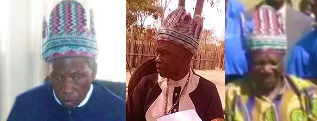
On 11th November 1880 the Evangelical
Congregation Church was founded (now called IECA). Following a series of
uprisings from 1902 to 1907, the Portuguese colonial officials closed all
catholic mission posts in 1910. They believed that the missionaries were behind
these uprisings and supporting pro-independence activities. According to Bible Society of Angola, the Chiluchazi New Testament was published in 1935. In 1935 the Seventh
Adventist missionaries established the Lucusse mission in Moxico province,
south of Luena town. By 1940 all native religions were abolished and outlawed in
Angola, and all were required to convert to Christianity. In 1963 the Mbimbiliya ya ku Lela was published.
The Luchazi have adopted Christianity and have been responsive to the Christian gospel. The membership of churches in Angola, Congo (DRC), Namibia and Zambia connected with Africa Evangelical Fellowship and Catholic Church is huge. Others are Apostolic Faith and Jehovah's Witnesses especially those in Western and North-Western provinces of Zambia.
Luchazi rites of passage
The Luchazi people have a rich tradition of celebrating the rites of passage of marking the end of childhood and the beginning of adult responsibilities. Important traditional institutions such as Mukanda, Mungonge, vuso and ciuila (chiwila) initiation ceremonies play a very significant role in the passage rites of boys and girls in the Luchazi society. These customary rituals of both men and women had, and still have, to be accorded the required mutual appreciation and respect due to them. This is the integral code of conduct handed to the Luchazi people from the ancestors and their chiefs; any relaxing or breach of these traditions lowers the high moral standards and status of the tribe.
Luchazi circumcision camp (Mukanda)
The boys are taken into the bush camp to be initiated
into the tribe as demanded by custom. Every boy at maturity is initiated into
the ceremonial life of the Luchazi people. Every Luchazi parent is expected to have
his son or male ward circumcised upon attainment of appropriate age. The
circumcision is normally performed by a skilled traditional doctor called
cikendzi who uses a traditional surgical knife to cut off the foreskin. The
operation is performed with no anaesthetic.
The idea to host a mukanda is brought up for
discussion by the father or guardian of the boys to be initiated. The father or
guardian of the head initiate is called cizika mukanda who is entrusted with
the overall organisation of the mukanda and performs the supernatural
activities (kuzika or kukoteka mukanda) of protecting the mukanda camp from
evil forces and wild animals like lions. Arrangements and consultations are
made within the community, then a circumciser (cikendzi) is hired. The uncircumcised
boys are mobilised and resources among the parents are pooled. It is usually arranged
for the head initiate to go and kill a housefly. After that he is given an
imitation wooden knife and told to stick the housefly at the sharp pointed end.
Then he is told to go and provoke the cikendzi (circumciser) by giving him the imitation
wooden knife as a challenge to his ability to exhibit his skill on him! The
head initiate and one or two others are circumcised on the first day at the
place known as lusumba on the verge of the village and taken to the mukanda
camp.
The head initiate who is circumcised first is called cizika
mukanda just like his father or guardian. Any additional uncircumcised boys are
also circumcised in similar manner as and when they are brought. The cizika
mukanda (father/guardian) gives strict orders to observe certain taboos which
ensures that all tundanda (initiates) are supernaturally protected from evil
forces. Some taboos/rules are given by the Cilombola, and these may include: no
salt, not to eat beans or catfish or vegetables seasoned with groundnuts etc.
These taboos vary from one cizika mukanda or Cilombola to another.
A mukanda camp is identified as for the Luchazi tribe
when it has two entrances; one on the eastern side and another on the western
side, with the window called ndambi situated several meters away from the
western entrance. One of the entrances is for use by the Vilombola and the other
entrance for use by initiates and Vilombola ntito. While a mukanda is identified
as Luvale when it has only one entrance, and on the opposite side the ndambi.
During their stay at mukanda, the boys now called
tundanda undergo a series of rites and experiences some of which would appear
to be cruel under normal circumstances. There, under the supervision of their
warden called Cilombola or Vilombola (plural), they are put through a course of
sprouts. They
are each subjected to sleeping in the open air in an individual roofless
enclosure of small sticks with an opening at the roof and fire on either side; no
blankets, these are tests of the boys' courage and endurance. During this healing phase, the initiates are not allowed to bath, and their movements are restricted. There is a Cilombola/Kalombola ntito whose duty is to fetch food and drinks for the initiates from
the village, and it is a requirement that as he is approaching the mukanda he
should sing a song and the tundanda should respond. There are songs for food such as civundu and songs for drinks. Failure to respond appropriately, entailed short rations, teasing and whipping. The boys are required to eat their meals without washing their hands; the only water given to them is for drinking (water discipline). This also presents an opportunity for adults to give instructions
under very hard circumstances, and during which the boys are trained to take on
physical hazards, the moral fibre to withstand any danger and the temptation to
reveal secrets and rites imparted to them.
During the initial stage, the tundanda (initiates) are taught manners, to obey orders and instructions from their parents/guardians without question, to participate in manual work, to eat their food communally with their fellow tundanda, to regard one another as blood friends, loyalty to the clan, tribe and service to the tribe, etc. They are also taught survival skills and encouraged to excel in these activities. These tasks teach them to appreciate the need for teamwork and leadership; teamwork teaches them to be assertive. These activities help boys develop personal skills such as how to take risks, how to handle criticism, and how to cooperate with those who are not their friends. This imparts a sense of creativity and adventure in the boys.
After three months, the initiates are presumed to be healed and a ceremonial ritual called kulonda tsimba is held. There is an all-night singing and dancing both at the mukanda camp and the village. At dawn a man or cilombola at the mukanda usually climbs on the top of the mukanda structure and mentions the names of the mothers of the initiates in the ritual song:
Upon hearing her name, the mother to the initiate ululates and dashes towards the mukanda camp and hurls a chicken towards the camp. During this ritual of kulonda ntsimba, mothers to the initiates and mature women gather at dawn on the verge of the mukanda camp, some armed also with whips ready to square off with men at the camp; if some rogue or mischievous women or women with dutch courage manage to breach the security and collect ashes from the camp fires, then the camp is regarded as "disgraced". Therefore, the entrances to the camp are heavily guarded on this day and the initiates are told to stay inside. On the other side, the makisi and men go out to fight the women with whips and to chase them away. After chasing the women away, after sunrise the initiates are taken to the river for their first bath since circumcision. The men continue to fend off a gang of women who are eagerly waiting to have a glimpse of the initiates. Once at the riverbank, men of the village form up a file with whips as the initiates jump the ritual fire as they go into the river for a bath, whipping the initiates for the last time. After bathing the boys are said to have completed the initial phase; corporal punishment is minimized, and they are allowed to carry out tasks without supervision; they are allowed to go out and collect firewood for the camp etc.
After the ritual of kulonda tsimba, a short period of time or so is allowed to pass and then the time comes where the boys are said to have been swallowed by the big Likisi. During this period, the mukanda is in total silence; no activity is allowed. Then the boys are introduced to the makisi of the mukanda for the first time, a terrifying moment for the initiates. After their introduction to the makisi, the boys are said to have been vomited out and are shown every corner of the camp. The boys are taught how to sing and dance; especially kukuua accompanied by wooden clippers and kutanga.
A man visiting the camp at night announces his approach by singing a song known as nguli which serves as a password, and the tundanda plus men present respond to his nguli. Most of the singing at the mukanda is call-and-response which is at times accompanied by wooden clippers. There are songs that are sung during the induction lessons at the mukanda. One of the common songs is:
Makisi the masked dancers
The makisi (masked dancers) are the rebirth of vakulu (ancestors) in new bodies specially brought back to life on the occasion of the coming-of-age ceremony (mukanda) of boys. According to Luchazi tradition, the makisi are the departed spirits (vakulu) that are associated with death and afterlife; they incarnate from the graveyards. The makisi are highly respected and feared. Therefore, it is inappropriate or not allowed to inquire about who is inside; the makisi speak in an accent different from humans. The primary role of the makisi is to protect the initiates and to defend the mukanda camp; they have weapons such as machetes, bow and arrows, axes and daggers. Many people mistakenly think these weapons are dancing tools. In ancient times, the masquerades were used to carry out surprise attacks on the rival communities. Throughout the mukanda process different types of masked dancers known as makisi (singular, likisi) appear at various stages.
The secondary role of the makisi is to provide entertainment by dancing in village square. The makisi are always accompanied by a group of initiated men who assist and protect them during these dances. The makisi also make the mukanda camp alive, warm and active place from beginning to end.
Traditionally, the masked dancers of the Luchazi are supernaturally protected (kukoteka); it is strictly a taboo for women to have any physical contact with any type of likisi, let alone have a handshake or hug a likisi. A woman who does so, suffers prolonged menstrual periods, and if uncircumcised man tried to uncover the likisi, he was strike with madness; touching or hugging a likisi by a woman or uninitiated man is considered an insult. Uncircumcised youth or man (Cilima) is not allowed to insult a likisi. This rule applies also to women. The first likisi to appear on the first day of mukanda is Katotola, who emerges early in the morning.
Katotola: is reincarnation of the dead man who has been transformed in the grave to look as he does with one white eye and one red eye because of his crooked ways. During the mukanda period, men take the opportunity to settle scores with women who have been perceived to be disrespectful by ensuring that the makisi whip these women. Women too take advantage of the presence of the makisi to discipline their children especially the naughty ones. They invite the passing makisi to come and snatch the bad children. The other makisi are:Ndondo: believed to be the incarnation of a dead youth who had a swollen belly because he wanted everything he could get his hands on and was never satisfied. So, this youth was bewitched because of such behaviour. This likisi is so full of jokes and fantastic idiosyncrasies that they are a delight to watch.

Chileya: Likisi Chileya is said to be the incarnation of a middle-aged man with greying hair who loved to spend most his time with women instead fellow men.
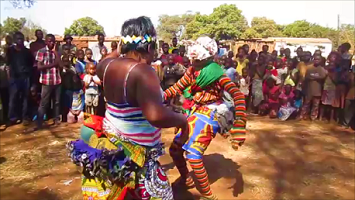

Other makisi are regarded as being more dignified and appear usually towards the end of the mukanda period. These are Muengo and Kangandzi who precede Lipumpu.
Lipumpu: He is the most dignified and highly respected of all the masked dancers. He is believed to be the reincarnation of an elderly ancestor specially brought back to life on the occasion of one of his descendants' (initiate's) final mukanda rites. He is portrayed in a transformed figure, with a colourfully pattern-painted face and a well-trimmed, ear-to-ear white beard. He travels whilst lifted up on the shoulders of a man, and only in the cool of the late afternoon. He is received at the miyombo (village ancestral shrine) with ritual pomp and ceremony.

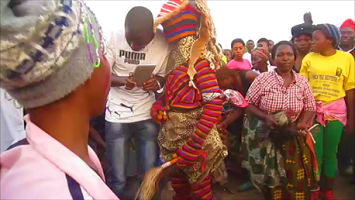
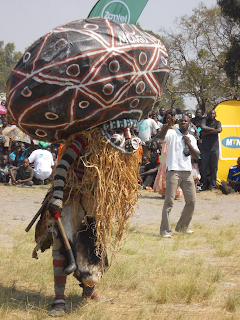
On the day of cessation of the mukanda rites (burning down of the camp), in the morning the initiates (tundanda) leave the camp. The initiates are told not to look back at the burning camp. On the verge of the mukanda camp or several metres away from the camp, the initiates are traditional decorated with pattern paintings of red and white ochre (mukundu and mpemba). A piece of cloth called mukotola is wrapped around the initiate’s bottom and between his legs and tied around the waist. A band made of trimmed thin fibre gins (ziondzi) called zindzombo/zintsambo is wrapped around the initiate’s waist. A headgear called cikuko is placed on his head and holds a single rattle (ntsangu) stuck to a stick.

After all the initiates are dressed, a Cilombola leads
them into a procession called kutanga as they move towards the centre of the
village, and finally the ndzango. Initiates first dance with their zindzombo by shaking rhythmically their waists to and fro called kuhunga. Afterwards the initiates dance moving their shoulders rhythmically up and down. At the end of
the celebrations, the boys are taken back to their various homes in accordance
with traditions. The following morning, the zindzombo, vikuko and mikotola are
buried secretly along the riverbank. The boys then bath and put on new clothes.
This gives them the sense of importance and sets them apart from all the uncircumcised
boys and females.
Mungonge
Nialupanda
Ndanga
Mbongo
Luchazi girls initiation rite (Vuso)
Vuso is the girls' initiation process which a Luchazi girl undergoes. It is held in dry season and can last one to three months. Girls are brought up by their mothers. Maternal care is one of the Luchazi women's most important instincts passed on from their biological parents and ancestors. All the girls who reach puberty are taken to Vuso. This is a traditional way of marking the end of childhood and the beginning of adult responsibilities. A thatched shelter called Cisevuilo is constructed at the rear of their mother's house where the girls will be spending their time during the day. In addition to Cisevuilo, a cone-shaped hut called Litungu is constructed in front of their mother's house facing the ndzango area, and this is the hut where the initiates sleep during the night. The Litungu is constructed by the fiancés of the girls if they are betrothed, or by their male cousins if not yet betrothed.
The initiation takes place in the morning, and it is carried out by initiated females at a secluded place within the village premises. Uninitiated girls are not allowed to be near this area; men are not allowed to pass near where the initiation is taking place, doing so would attract violent beating from the women. After the process, the initiates called va niamuso are covered in clothes from head to below the knees with part of the cloth used as veils for their heads and faces. In the afternoon before the sunset, the initiates are taken to the cisevuilo amid singing and dancing by women. Other women carry whips, and men including children of the village are at their mercy! In the initiation camp, the girls undergo their maidenhood seclusion stay. Here they might stay three months or more, and uninitiated girls are not allowed to enter girl's initiation camp. It is also strictly taboo for men to enter any girls' initiation camp; men who are foolhardy enough to do so, do it on the pain of strong condemnation by other men of the village and the heavy compensatory punishment to be meted out by the headman or chief.
In most Luchazi villages and communities, close relatives such as aunts, grandmothers, grand-aunts, elder sisters and cousins all played a role in the upbringing of a girl child. She is taught to listen to and accept advice from well-meaning women, particularly the elderly. She is taught that a Luchazi women's place is first and foremost in the field and then in the kitchen. She is taught the importance of working hard in her fields and be self-sufficient in the production of food for herself and family; taught how to process and preserve various foodstuffs such as, cassava, leafy vegetables, mushroom, etc. She is taught the varied crafts of cooking, sewing, basketry, pottery and housekeeping. She is prepared for the tasks as woman in the Luchazi society. She is also taught to behave like a well-bred woman at all times in all places and in all circumstances. She is forbidden to associate or indeed have sexual relationship with uncircumcised men.
During Vuso, dances are held in the late afternoons where women showcase their dancing skills and the participants are exclusively women, with only a few men who play the drums. This dance is called nteta. Men are mere spectators who give tokens of appreciation to the dancers.
Ndzango
Luchazi traditional marriage
The Luchazi people have clearly defined ways of choosing a mate according to their traditions. These include marriage by bride price, marriage by capture, and kuzikila.
Marriage by capture occurred when men from a victorious village took women from conquered groups as wives, while the captured men were sold into slavery.
Kuzikila was a rarer custom, in which a girl was betrothed either on the day of her birth or while still in her mother’s womb. Children of good families were often promised in marriage before they were even born. The process worked as follows: if a man (a cindunduka ca yala, the only young adult male permitted to perform the ritual) was interested in kuzikila with a friend whose wife was pregnant, he would smear white chalk (mpemba) on the pregnant woman’s stomach and declare that if the child were a girl, she would become his future wife; if a boy, he would become his friend.
If a girl was born, the man then completed all traditional marriage rites and took on the duty of caring for her until she came of age. This waiting period was called kuzikila. However, such arrangements were always subject to Luchazi traditions and family choice. Wise parents considered the age and social standing of the prospective husband, as well as his character. From infancy, the girl was told who her future husband was. Around age fifteen, she entered vuso, where she was prepared for her role as a wife—learning to care for a home and raise a family. During vuso, she was taught various domestic crafts, including cooking and housekeeping.
In marriage by bride price, a young man who had interest in a girl would first raise the matter with his uncle, grandparents, or parents. Consultations would then be held among family elders, who considered the attributes of the potential mate. It was vital that the family one married into possessed reasonable wealth, good connections, and proper behaviour.
In the past, endogamy (kuli tuva mpoko)—marriage within the family, village, tribe, or clan—was common, and intermarriage with other tribes was prohibited. This helped keep Luchazi heritage free from outside influence. Most Luchazi groups encouraged their children to marry within the stem family (especially where their grandparents or great-grandparents had married from) or clan, so that family values and heritage were preserved. Marriages outside the stem lineage were avoided due to heavy penalties that could follow the death of a child or wife. It is no wonder that the important matter of marriage was not left entirely to the young man or woman.
Because marriage was a family affair, it was never left solely to the individuals. Even today, no decent Luchazi would marry without their family’s consent. The decision was made by uncles, parents, or a full council of relatives—those who bore responsibility for family property—and they deliberated carefully before committing.
When the uncles or parents were satisfied that a young man was ready for marriage (i.e., he had a farming field and other essentials to support a wife), the first consideration was whether the potential mate stood in the proper relationship to the family. This question of kinship was of greatest importance to the family council. Once it was established that the bride or groom’s family was an acceptable one to marry into, they considered the second question: what advantages the family had to offer. In the old days, marriage was one of the few roads to fortune—boys and girls could improve their social standing through marriage. Marrying into a poor or unimportant family might ruin a young person’s chances for a successful life. Therefore, uncles or the family council spent much time and effort ensuring the right choice. The third consideration was the young person’s character: hardworking, industrious, and good-tempered.
After the elders gave their approval, the man asked the woman to marry him. If both agreed, the man gave the woman a token, which she presented to her grandmother or mother. The man’s family then appointed an intermediary called kanganda, who took an initial payment known as njimbu (an axe) to the girl’s family and arranged a meeting to negotiate the bride price. On the appointed day, the uncle or relatives went to the girl’s village to negotiate.
The Luchazi are an agricultural people, so in the old days the bride price was often paid in iron hoes (matemo). After the bride price was paid to the woman’s relatives and any other traditional formalities were completed, the woman was ceremoniously escorted to the man’s home, and the two became husband and wife.
Once in her husband’s home, the woman used her mother-in-law’s kitchen (ntsenge) to cook; she was not allowed to cook in her own kitchen until the ceremony called kuvueka coto. After about a week, the woman’s relatives performed kuvueka coto ceremony, bringing cooked foods to the man’s village. The purpose was to show the man’s relatives that their daughter had been well trained—the food presented represented the standard she would always cook to. The woman’s relatives also gave gifts of preserved foods: calabashes of dried groundnuts, pumpkin seeds, mutete, mushrooms, and baskets or sacks of processed dried cassava tubers. Once the ceremony was performed, the woman was free to cook from her own kitchen (ntsenge) and serve in the ndzango. From then on, the man automatically became responsible for her well-being.
Women and children are considered valuable to the tribe. Upon the birth of a couple’s first child, the child’s name is used to refer to the parents—for example, SaChiyena (father of Chiyena) or NiaChiyena (mother of Chiyena). It is considered inappropriate to call a person who has children by their first name. This system of naming, it is believed, binds the core family together and emphasizes the importance of raising children.
Marriage Taboos, Trials, and the Sanctity of Marriage
Health and Maternity Taboos
Traditional Luchazi law imposed a strict taboo on sexual intercourse for breastfeeding mothers until the child reached at least two years of age. It was believed that a new pregnancy would "spoil" the mother’s milk and cause the nursing child to fall ill due to premature-weaning (Vuse). In a practical sense, this served as a vital safeguard against malnutrition (Vulili), ensuring the child was fully weaned and strong before the mother conceived again.
Dietary and ritual restrictions also governed pregnancy. For instance, expectant mothers were forbidden from eating eggs to prevent prolonged labour. Furthermore, if a husband had been unfaithful during his wife's pregnancy, he was required to knock on the door and wait for his wife to step outside before he entered. This ritual was believed to cleanse the home and ensure a safe delivery; ignoring it was thought to lead to complications during childbirth.
Family Protection and Compensation
The community maintained strong sanctions against the mistreatment of women. If a wife suffered a physical injury or fell ill due to neglect during the marriage, the husband was required to pay compensation (vikuka) to her relatives. Should a wife die while in her husband's care, the compensation was exceptionally high. In the past, vikuka—which included livestock and manufactured goods—was a communal debt collected from the husband’s entire extended family.
Resilience Under the "Estatuto do Indigenato"
The Luchazi view marriage as a sacred bond to be preserved at all costs, a belief tested during the era of forced labour (Estatuto do indigenato) in Angola. While men were sent to plantations for months or years, women were forced into grueling road maintenance work, where many suffered sexual abuse and became pregnant.
Remarkably, these women were not marginalized. As one woman told researcher Edward Ross, survivors were welcomed back with support rather than shame, for the community recognized that both men and women were victims of colonial violation. This led to a cultural standard: a husband returning from forced labour or a long trade expedition could not divorce a wife who had become pregnant in his absence. He was obligated to raise the child as his own, and the biological father was barred from making any future claims.
Divorce and Polygamy
While the Luchazi strive for unity, divorce does occur for reasons such as infertility, impotence, cruelty, or laziness. Interestingly, adultery is rarely cited as the official reason for divorce; to do so was considered an insult to oneself, as it implied the spouse had failed in their "matrimonial duties." Instead, a family might cite "talkativeness" or "laziness" as the formal grievance. This is reflected in the sayings of certain lineages, like the Va ka Sachisunga, who suggest that while a child binds a family together, a "troublesome" wife without children may be sent away.
Though discouraged by Christian missions, polygamy remains a part of Luchazi life for those who can provide for multiple households. A much rarer historical custom was kuli solokela, a practice of wife-lending between close friends. In this tradition, a man would offer his wife to a friend in exchange for a goat, after which the husband would temporarily leave the village to grant the pair privacy.
Luchazi Royal marriage
The selection of a Mukuetunga (royal consort) follows a strictly defined traditional procedure. When a young Chieftainess or Princess is deemed ready for marriage, the reigning Chief initiates consultations with the elders of the royal family and the Chief’s advisors.Together with the Princess, this group suggests several potential candidates. Each man is carefully scrutinized for his character and social attributes. A shortlist is then presented to the reigning monarch for review, and a final selection is made—once again in consultation with the royal lady concerned.
To finalize the engagement, one of the Chief’s advisors is dispatched to the chosen man's village. Upon finding him, the advisor performs a sacred ritual: using a reed straw, he sprays mazi a boma (python oil) onto the brow of the selected man, officially marking him as the royal consort.
Luchazi names
Sons
|
Daughters
|
Ndala (firstborn)
|
Ntumba (firstborn)
|
Ntsandala (second born)
|
Mutango (second)
|
Ntsamba (third born)
|
Kakuhu (third)
|
Kasanga (fourth born)
|
Mbakakuhu (fourth)
|
Ntsakasanga (fifth born)
|
Mbakakuhuluila (fifth)
|
Kasongo (sixth born)
|
Kasongo (sixth)
|
Ndakasongo (seventh born)
|
Mbakasongo (seventh)
|
Ndakasongoluela (eighth born)
|
Mbakasongoluela (eighth)
|
- Mixed twins (boy and girl); Njamba (or Nguvu) for the boy, and Ngeve for the girl.
- Twins (both boys); Cilunda (Chilunda) for the first born and Muntomba for the second born.
- Twins (both girls); Cinenge (Chinenge) for the first born and Mbacinenge (Mbachinenge) for the second born.
- Kahalu: the name is given to the surviving female twin after the death of the boy.
- Kanianga (kanyanga): the name given to the surviving male twin.
- Kafuti: the name is given to the baby born immediately after twins.
- Kanianga (kanyanga): the name is given to a male baby whose mother died at birth.
- Masela: the name is given to a baby whose father died before the child was born, either boy or girl.
- Cipango: taken from the name of the Cipango fertility ritual isolation shelter itself.
- Vihemba: taken from the medicine used during fertility ritual.
- Kasueka (Kasweka): refers to the mother's restriction to the Chipango shelter during pregnancy.
- Calula (Chalula): attest to the efficacy of the medicines used.
- Vilengeya: also attest to the efficacy of the medicines used during fertility ritual.
- Vihinda: refers to roots that were used as medicine.
Family names (Surnames) and nicknames
The use of the Portuguese language by many Angolan
tribes dates back hundreds of years; some were able to speak and read
Portuguese as early as 1491 especially those along the north-western Atlantic
coast. As these tribes embraced Christianity, they adopted Portuguese, English
and Afrikaans names after baptism, but many Luchazi people have maintained
their naming tradition.
The family names or surnames which most Luchazi people have are a recent possession. In the past, people had only one name at a time. However, the Luchazi people being a matrilineal tribe would refer to a person by her mother's name; examples: Chipipa ca Vuime (Chipipa son of vuime - Vuime is the mother), Kakuhu ka Kalemba (Kakuhu daughter of Kalemba), Ngongola ya Kanunga (Ngongola son of Kanunga), Mutunda ua Ngambo (Mutunda son of Ngambo), Katolo ka Chindamba (Katolo son of Chindamba), etc.
There are also nicknames given to individuals in line with their personality or character. Battle names were given to warriors and others also added descriptive praise name such as Tovola ya Visali (the one who caught fish in streams) for Muangana Mueni Kwenye, Mutandeveyo ua Zinjila (he who spreads his legs across paths; the toll collector from travelers) for Muangana Mueni Kavangu, or Kazika Mazila (he who blocks paths; toll collector). Others changed their names after some achievements, thus indicating a new personality, or another chapter in their lives. Traditionally, it is a taboo to call someone by his or her name after sunset.
Luchazi traditional funerals and burials
Traditionally, all the fires of the village are extinguished after the death of a member of the village especially a headman. All mourners are required to camp outside the house of the deceased.
Traditionally, the corpse is not allowed to pass through the door of the house. Children are not allowed to see a corpse, and an opening is made at the back of house where the corpse is extracted. The corpse is usually placed on a bier known as vuhango. If all customs are done, the deceased is buried in a grave at a village cemetery with the head placed in the eastern direction. Household utensils used by the deceased such as plates or cups or pots are placed on top of the grave (mbumbo). After the dispersal rites, the house of the deceased is demolished (and the ruins or place is referred to as mbozo) especially if the deceased used to live alone in the house.
Marriage customs determine what is to be done if the husband or wife or child dies. The death of a husband doesn’t seriously affect the situation on ground. But if a wife or child of a Luchazi village dies, it constitutes a very serious offence for the entire village, except fellow bride-price women and their children. As a matrilineal tribe, the children of the Luchazi marriage are presumed to belong to the mother. If a child dies the father pays something in lieu of the dead child to the brother or uncle of the wife. In old days, the reasoning was that since the child was going to be counted in its mother's matrilineal village, a replacement should be made accordingly.
The death is announced to the village of the deceased
woman's relatives by a messenger sent from the widower's village who shouts the
bad news from the verge of the village and immediately runs back for fear of
being harassed or beaten. The mourning relatives of the dead woman will then go
in a procession to the husband's village and stop on the verge of that village,
with women crying and wailing. A goat is then offered to them which they
slaughtered there and then. The first goat offered is known as cisanga-ninga.
The mourning group then enters the village with the
slaughtered goat and camp in the front yard of the funeral house. The widower
is then confined or was placed in seclusion and supervised during the period of
mourning. A series of animal offerings at various stages of the mourning rites
follows. A female relative of the deceased is appointed to cook for the widower
and to generally serve him routinely by way of giving him water to drink,
lighting a fire at night for him to warm himself. Before these services are
provided, the widower or his relatives are required to pay for these services.
Failure to pay results in the widower being starved, but in any case, the
widower is just served water whether the relatives paid or not. During the
funeral the widower is not allowed to bathe or touch the fireplace.
After the payment of services for the widower, the male relatives of the deceased demand compensation for the loss of their deceased relative and all relatives of widower are required to contribute something towards the payment. In old times, they would demand a minimum quantity of goods to be made as initial payment by marking a four-sided space with four poles about the height of a man to be filled with goods. Burial cannot be authorized unless a reasonable amount is paid. Once the initial payment has been made, burial takes place at the village graveyard. The widower is not allowed to attend the burial and is taken into the bush where cleansing rituals commence. After burial the widower is returned home.
Sexual cleansing ritual
During the cleansing rituals the widower is required
to be personally involved in the sexual cleansing ritual in which he engages in
sexual intercourse overnight with a chosen female. Demands for compensation are
suspended during the performance of cleansing rituals.
The day after burial and cleansing ritual, demands for
more payments and negotiations resume. After reaching an agreement, a
reasonable lapse of time is then allowed after which the final payment of
compensation should be made. After payment, the case is closed. Then relatives
of the dead wife are expected to provide a substitute as a new wife.
If after the deadline the widower and his relatives
failed to make the final payment of compensation for any excuse whatsoever,
then the relatives of the deceased refer the matter to their chief. The chief
invites some headmen to accompany him and visit the widower's village at the
throng, camping on the verge of the widower's village, later move to a nearby
village after the widower has paid another cisanga-ninga.
Whenever such a case is referred to the chief for his
ruling, the action of the dead wife's relatives is always upheld. If the chief
is satisfied that the failure to pay is deliberate, he intervenes with more
firmness. He orders the widower to pay off the remaining major portion of the
compensation in the form of two or three cattle. In old days, a temporary
indentured worker known as ntompo would be paid in lieu of cattle, and if the
husband and his relatives cannot afford an indentured worker, his nephew or
niece or even himself could be snatched in lieu and later be sold as slaves for
goods.
Once the matter is settled, the chief is also paid for
his intervention. In old days he was given an able-bodied young man called
ntungisi to supplement the workforce at his palisade! Gradually this act of
heavy compensation led to men having secret affairs with their sister-in-laws
(vampuevo zia matemo).
Inheritance
In older times when the father of a family died, one of the nephews inherited his uncle’s estates including his aunties. The Luchazi now practice western patterns of inheritance. There are still matrilineal families in parts of the Luchazi communities, but they are slowly passing due to intermarriages. In modern times, the state has taken over most of the roles and functions of clans in education, protection of members, social and economic help.
List of prominent Luchazi people
1. Business, economics and politics
- Enoch P. Kavindele: Born on 7th July 1950. He is a businessman who established Woodgate Holdings in the 1970s. He is also a politician who started his political career as Member of Parliament of Chingola constituency in 1987 under the United National Independence Party (UNIP). He joined Multi Party Movement for Democracy (MMD) and served as Republican Vice President of Zambia from 2001 to 2003. He is the Chairman of the North-Western Railway Company.

2. Art and media
- Enock Kaleji: He is the best ever Luchazi traditional folk singer.
- Mingeli Palata: He is a broadcaster; a filmmaker and a script writer. In 2014, he was a double nominee in the Zambia Film Television and Radio Awards (ZAFTARS) for Best feature "Beautiful lie" and Best script writer "Foolish me". In 2015, he become Africa Magic Viewer's Choice Awards nominee for Best TV series for "Maliposa".
3. Sports
- Chisanda Mutti, nicknamed as "Kent Green", was born on 14 February 1957 in Matero, Lusaka Zambia. He was a professional middleweight boxer, light heavyweight, cruiserweight and heavyweight boxer. He is the only Zambian boxer to have fought the great Evander Holyfield; Evander Holyfield vs. Chisanda Mutti. The double knock down in Lee Roy Murphy vs Chisanda Mutti on October 19, 1985, has entered the Boxing Hall of Fame as one of the greatest double knockdowns ever.

Author's note: Now that the guns are silent in Angola, it is time to embark on a journey of historical and cultural enquiry about the Luchazi people. This blog is largely the result of an extensive compilation effort. The information is from sources ranging from the early European Christian missionaries to the present senior citizens (vivendzi) of the Luchazi tribe. It contains oral historical and cultural information from the Luchazi people themselves as handed over to them by their forefathers; these oral accounts which had already been validated by the Luchazi themselves via Cikota ca Luchazi. Other sources of information include renown encyclopaedias. I wish to state that the blog will be constantly updated or edited as and when new information is provided and validated by Cikota ca Luchazi. They say that the past is brought to life by those who were there. And to understand the present, you have to understand the past. History is not only events, it is also about culture.
The book entitled: "The Luchazi people - Origins and History" is now available on Amazon. Get your copy.


Beautiful history i am delighted to read, just disturbed on the defficient list of the prominents! Meaning we have not done much as Luchazis.
ReplyDeleteThis is very good information. Keep it up!
ReplyDeleteWell reasearched. If possible would be good to get some commentary on Mwene Kalunga & Mwene Mutunda Wa Ngambo. Twa sangala mwanetu
ReplyDeleteTua sangala muane this is very important to know,we salute you muata for such a wonderful package of information about Luchazi people..Njambi akale nenu ntsimbu yose..
ReplyDeleteInteresting. This cultural community is also found in Botswana in the North West District in what are known as Etsha villages.
ReplyDeleteInteresting piece, tua sansela. We need more of this, i don't even know our traditional attires
ReplyDeleteThis is good, I at least have an idea about the rich history we have. Let's keep pushing for more.
ReplyDeleteAnge ni njika'ngengela wa ku Wila-Luvango. Vaci ngweni ngangela ili lika ku Kwandu na KUVANGU, ou Moxiku, ku Vie na ku Kunene. Luvango lukala kuliko?
ReplyDeleteOs ngangelas não só estão no Moxico, Bié, Malanje, K.K, Cunene, mas sim na província da Huíla ocupando uma vasta região, desde o leste do Município da Matala (depois.do rio Cunene) Até KUVANGU, Jamba mineira.
ReplyDeleteInteresting.
ReplyDeleteTu na sangala muakama. Zinguli ngeci muezi zisilivila muamo ngambo.